
 Dr. A. K. Merchant*
AS the turmoil of the Age of Frustration accelerates, the fulfilment of the prophetic warning Bahá’u’lláh, Founder of the Bahá’i Faith, made over a century ago that “an unforeseen calamity” was following the peoples of the world and “that grievous retribution awaiteth them” seems imminent. However, this should be a cause of dismay and hopelessness because Bahá’u’lláh’s vision of a civilization is rooted in the belief that all people have been created to carry forward an ever-advancing civilization. Bahá’ís believe that humanity stands “on the threshold of an Age whose convulsions proclaim alike the death-pangs of the old order and birth-pangs of the new.” Every thing happening in the world is compelling us to “experience [the] stirrings in the womb of a travailing age—an age waiting for the appointed hour at which [time] it can cast its burden and yield its fairest fruit.”
To understand the processes set in motion, “…each of the successive crises in the fortunes of a decadent age exposes more convincingly than the one preceding it the corrosive influences that are fast sapping the vitality and undermining the basis of its declining institutions,” both secular as well as religious. For a significant section of present-day society, the prospect of reconfiguring present arrangements based on noble ideals such as unity and justice might appear too idealistic, even ill-timed given the chaotic state of the world. Yet to suggest that the far-reaching transformation would be better suited for another time would be unconscionable on the part of today’s world leaders. The great retributive calamity, for which these leaders are answerable,” followers of Bahá’u’lláh believe, is a divine chastisement designed to awaken them and the peoples to whom they are responsible to embrace the truth of the redemptive Message bequeathed them over one-hundred-fifty years.
Thwarting the implementation of God’s purpose for humankind and getting entrapped in the worship those false idols, untruths and half-truths which have demolished the ethical foundations of civilization, as we know it, corrupted its spiritual life, convulsed its political institutions, corroded its social fabric, and shattered its economic structure would only prolong the suffering and misery of the vast multitudes.
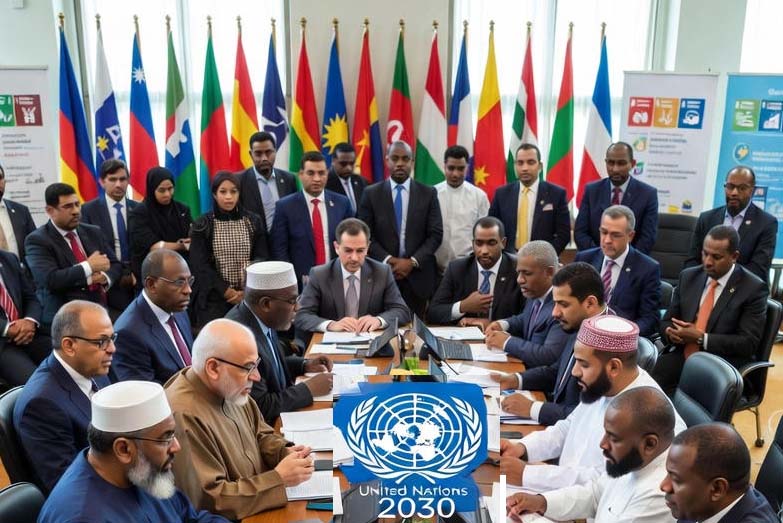
Recognizing humanity’s oneness, the pivotal principle which all nations must uphold and embracing interdependence as the shared destiny of the planet world leaders must overcome the paralysis of will and counteract the inertia of the status quo. They will need to employ new forms of statecraft founded on greater degrees of unity. Whatever decisions are made and policies proposed or action need to be taken, world leaders must ask themselves: will this decision advance the good of humanity in its entirety? It is strange that when all the member states endorsed the Agenda 2030—Sustainable Development Goals in 2015 and got it ratified by their respective governments there was great hope that better days were ahead and the pathway for a united world would percolate very strata of society—inclusive and universal—leaving no one behind. Alas, all those high expectations were short lived and soon new tragedies and fresh forms of devastation erupted. Such contradictions between aspiration and action is a recurrent feature on the international arena as evidenced at the UN General Assembly held annually, whether in the domain of peace and security, poverty alleviation, or the advancement of women, among others.
The tendency toward skepticism and caution that prevents meaningful and enduring action is understandable when set against a painful history of countless breaches of trust. No wonder, the current plight of the world we inhabit and humanity’s growing interconnectedness demand movement from words to deeds. The role of leadership, both secular and religious, then goes beyond asserting what should be done, to creating an enabling environment where the necessary actions can be taken.
Acutely aware of the crying needs of the times, and “conscious of their high calling, confident in the society-building power which their Faith possesses, [the Bahá’ís] press forward undeterred and undismayed, in their efforts to fashion and prefect the necessary instruments where in the [new] World Order of Bahá’u’lláh can mature and develop. It is this building process, slow and unobtrusive, to which the life of the worldwide Bahá’i Community is wholly consecrated,…” Such an understanding and action program is strongly reinforced by their belief that religious truth is not absolute, it is progressive and evolutionary. Every person must independently search after truth, condemn all forms of superstition and prejudice, uphold the harmony between science and religion.
Every Bahá’i activity alongside the contribution of many other religious and spiritual organizations should ensure equal opportunity, rights and privileges for both sexes, compulsory education, the abolition of extremes of poverty and wealth, promote the worship of that sole supreme Divinity coupled with service to the society comprising the three protagonists—individuals, institutions and communities. Additionally, followers of all religions should eradicate conflicts due to linguistic diversity and recommend the adoption of an auxiliary international language. Such a worldview would lead to the creation of the necessary agencies and emergence of structures for the establishment and safeguarding of a permanent universal peace. All of the above initiatives and activities contribute effectively to realization of the 17 Sustainable Developments Goals with its 169 targets and 238 indicators of the UN Agenda 2030. And pave the way for the emergence of a divine civilization as foretold in the Sacred Scriptures of all the religions aka dharma including the Bahá’i Faith.
*The writer is a social worker, an independent researcher, & member of the Bahá’i Community of India.