
 Dr. A. K. Merchant*
Every nation, every community, religious or secular has its own record of what happened in the past, how it is impacting the present and what future could unfold. The recent debate on the 150th anniversary of the composition of the national song Vande Mataram has prompted me to reflect on how the followers of Baha’u’llah, Founder of the Bahá’í Faith view human history. Although human existence on the planet is reckoned in terms of several hundred years, our record of different civilizations is approximately 10,000 years. As per the Bahá’í Writings: “history, prior to Alexander of Greece, is extremely confused, for it is a fact that only after Alexander did history become an orderly and systematized discipline. One cannot, for this reason, rely upon traditions and reported historical events that have come down from before the days of Alexander… The histories prior to Alexander, which were based on oral accounts current among the people, were put together later on. There are great discrepancies among them,…[this] is an accepted fact among historians … and that prior to his time history was transmitted by word of mouth.”
Many societies have chronicles on and more than one narrative. For, time moves on inexorably, just as the sun and moon pass through the sky day after day, night after night, weeks and months and years roll by and before we know it a fresh historical narrative emerges. We are still seeking answers for the precise cause of the French Revolution and many others, if one cause there were. Thomas Carlyle, historian and well-known author, saw the force of change in history as deep and inscrutable: “…as was once written, ‘though our clock strikes when there is change from hour to hour, no hammer in the Horologe of Time peals through the Universe to proclaim that there is change from era to era’. The true Beginning is oftenest unnoticed and unnoticeable. Thus, do men go wrong in their reckoning; and grope hither and thither, not knowing where they are, in what course their history runs.”
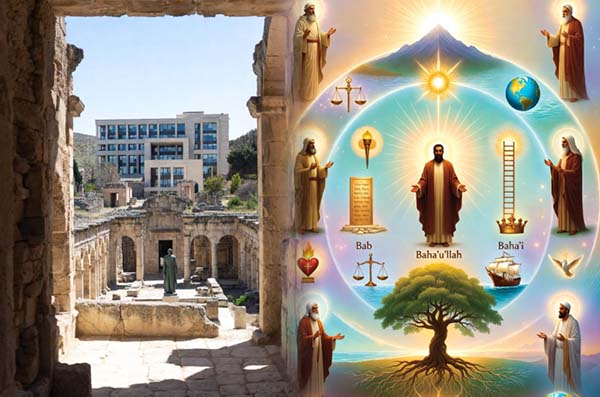
Members of the Bahá’í Faith regard the unfoldment of history as a divinely guided process of spiritual and social evolution, moving toward the ultimate goal of unity and peace. History is a powerful instrument. It provides a perspective on the past and casts a light on the future. Humanity is seen as one family progressing through stages of development, with each religion contributing to this unfolding story. In essence, the history of humankind should be understood in the light of what societies did when God, the supreme Divinity, sent messengers from Age to Age—such as Sri Krishna, Buddha, Abraham, Moses, Jesus, Muhammad [pbuh], and Bahá’u’lláh for our current Era. Their Messages to different sections of the human population in different places are not contradictory and never meant to be a cause of conflict but part of one continuous process, guiding humanity step by step toward greater unity. The saints, heroes and martyrs that remembered were the cause of a new awakening. In the great body of literature and legend that is now accessible, history’s hand can be seen at work shaping much of the course of civilization, as we know it. In the legends that have inspired the ideals of every people since the dawn of recorded time, as well as in the epics of the Ramayana and the Mahabharata, in the exploits celebrated in the Odyssey and the Aeneid, in the Nordic sagas, in the Shahnameh and in much of the Bible, the Qur’an and Sacred Texts of Buddhism, Jainism, Parsi-Zoroastrian, may be discovered the process of the spiritual evolution of humankind analogous to the stages of infancy and childhood in the lives of its individual members, then moving into an adolescence phase of empires and nation-states that is now culminating towards its long-awaited adulthood.
The Bahá’í Faith regards the current, highly charged and uncertain period and calamitous condition in human affairs as a natural phase in an organic process leading ultimately and irresistibly to the unification of the human race in a single socio-economic and political order whose boundaries are those of the planet. The historical process must be seen as a series of lessons preparing humanity for building a peaceful, just, and unified world civilization. Wars, divisions, and injustices are interpreted as growing pains of humanity learning to live together.
Bahá’u’lláh’s Revelation offers the blueprint for humanity’s current stage—the transition to global unity. His vision includes the abolition of prejudice, equality of men and women, harmony of science and religion, and collective security.
In essence, the Bahá’í Faith sees history not as random or chaotic, but as a purposeful journey toward unity, with religion aka dharma acting as the guiding light at each stage. Vande Mataram was written in the 1870s and remained unpublished. It was expanded to few more stanzas and made the part of Bankim Chandra Chatterjee’s novel Anand Math. As the National Song if it helps to strengthen the bonds of unity among the peoples of India it should be whole-heartedly welcomed. India’s struggle against the British Raj was multi-religious, multilingual and multi-ethnic. Women and men both took part to ensure that a united Bharat emerges. The Constituent Assembly in a way represented the aspirations of all peoples and that time they had settled the issues of the National Song and the National Anthem. Therefore, what is the point for acrimonious debate and the resultant polarization? We have so many other urgent and overarching issues in our struggle to attain the goal of a Viksit Bharat.
As the issues surrounding our planet’s survival become urgent, let us stay away from contradictions and instead dispassionately examine humankind’s historical predicament. Satisfaction on such common topics would enable all the citizens to accelerate the process of strengthening the nation against those wishing to create roadblocks. Let all choose to encourage each other and look to the larger good. Our histories should help make sense of the world—and human experience. It should provide inspiration, consolation in times of grief and enlightenment to march forward with a conviction that ultimately, we shall all emerge victorious.
———————————————–
*The writer is a social worker, independent researcher & member of the Bahá’í Community of India