By Rahul Shastri / Yogendra Yadav :
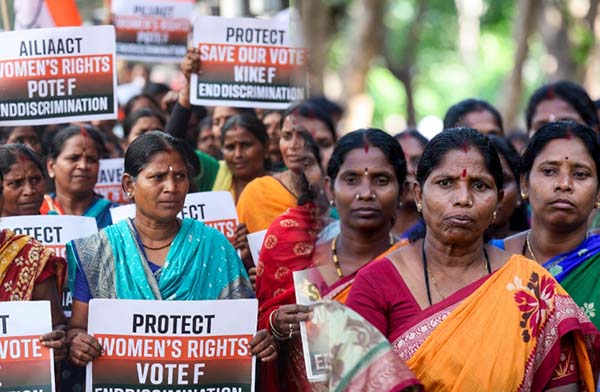
A future historian might record this cruel irony: Just when women were beginning to be recognised as political actors in their own right, the largest-ever disenfranchisement of women occurred in India. She might wonder why and how it happened in the third decade of the 21st century, when the whole world had taken women’s suffrage for granted. This is where she would encounter “Special Intensive Revision” of electoral rolls.
Now that we have the data from all states except Uttar Pradesh for the second phase of the SIR, it is clear that we are witnessing the single biggest reversal of decades of gains on women’s electoral participation. In the last two decades, we have seen improvement in women’s enrolment, in turnout of women voters and a distinct focus on women’s issues. The SIR threatens to take us back to the basic struggle for women’s voting rights.
In India, women’s voting clout has historically suffered from a double whammy. The first is a phenomenon identified by Amartya Sen as the “missing girl child”: A vast gap between the number of girls expected to be born, going by the natural birth rate, and the actual number of girls who are born. The second phenomenon is women’s under-enfranchisement — the women who do reach the age of voting are less likely to be on the voters’ list than men. The SIR has now made it a triple whammy for Indian women by introducing a new phenomenon: Disenfranchisement of women who were already on the voters’ list. Independent India has never seen this phenomenon at this scale.
Bihar gave us the first glimpse of what was to come. Before the SIR, the gender ratio in Bihar’s population was 932 — for every 1,000 men in Bihar’s adult population, there were only 932 women. The voters’ list made it worse. For every 1,000 men on the voters’ list, there were only 914 women — fewer than their share in the population. The list should have had 7 lakh more women if the share of women was the same as in the population. After the SIR, the gender ratio in the final voters’ list of Bihar fell sharply to 890. Thus, thanks to the SIR, the number of “missing women voters” increased from 7 lakh to 16 lakh. In Bihar, the SIR wiped out a whole decade’s gain in the gender ratio of electoral rolls.
The data from the second phase of the SIR confirms that what happened in Bihar was not an anomaly. The accompanying table presents the data for six major states in the second phase. In every case, the SIR has led to a decline in the gender ratio of the voters’ list. On average, these six states had 979 women for every 1,000 men in their pre-SIR voters’ list. This was a little less than their share in the adult population — 985. Now look at the impact of the SIR: The gender ratio in the draft voters’ list declined to 963. This steep drop translated into 23 lakh additional “missing women voters”. In other words, if the SIR exclusions were proportionally the same for men and women, we would have had 23 lakh more women on the draft voters’ list than we have on the draft lists for the second phase.
We don’t have the gender-wise data for UP (and Chhattisgarh) yet. In all probability, the number of “missing women voters” will shoot up then. This list of six states happens to include Kerala and Tamil Nadu, which are among the best states in terms of their gender ratio. Even in these states, where the number of women on the voters’ list is higher than men, the SIR has led to a drop in the gender ratio — 2 points in Tamil Nadu and 14 points in Kerala. As expected, the other states fare much worse, dropping by more than 15 points each. Thus, the SIR has already wiped off nearly 6 lakh women voters Gujarat, more than 5 lakh in Rajasthan and West Bengal and almost 5 lakh women voters in Madhya Pradesh. Contrast this with Assam, the only state that has not used enumeration forms and “mapping” requirements for its recent voter list revision. Here, the Special Revision has actually led to an improvement in the gender ratio, from 1,002 to 1004. Clearly, SIR is the culprit.
As in the case of Bihar, the SIR has reversed long-term gains in the proportion of women on the voters’ list in these states. Take MP, for example. In 2009, the gender ratio of its voters’ list was abysmally low at 887. Thanks to the ECI’s sustained efforts, the ratio improved in every subsequent revision and reached 950 last year, matching the actual share of women in its adult population. The SIR draft list brought it down to 933.
There is little surprise in this. The SIR suffers from a design defect that works to the disadvantage of women. The requirement of filling an enumeration form with a photograph by a harsh deadline is a classic device of what scholars call administrative disenfranchisement. It is not surprising that more women have been excluded on the grounds of being “absent/shifted”. An overwhelming proportion of these are married women whose names have now been deleted from their maternal home, but never included in their married home. But this is not all. Further disenfranchisement awaits those women who are on the draft list but cannot “map” themselves to their parents (in-laws are not allowed for this purpose), in two-decade-old electoral rolls. This is plain discrimination against married women.
When our future historian looks at this data, she might also chance upon the ECI’s Manual on Electoral Rolls. She might be struck by how sensitive the ECI’s rules and procedures were when it came to women’s enrolment. She might notice that the ECI’s own manual required it to monitor the gender ratio at each stage, carry out physical verification and appoint female BLOs in case of any imbalance in the gender ratio. She might wonder how the Special Intensive Revision of the voters’ list turned into a very special intensive deletion of women voters.