 Najmuddin A Farooqi.
The phrase “Greater Israel” is frequently invoked in political debates and social media discussions concerning the policies of the modern State of Israel. It is often associated with the belief that Israel seeks to expand its territorial boundaries across large parts of the Middle East. However, when examined in light of historical context and contemporary realities particularly the status of Muslims living within Israel the concept appears far more complex than popular narratives suggest.
Muslims constitute the largest minority community in Israel. Their population is estimated at about 1.8 million people, roughly 18 percent of the country’s total population. The community maintains an extensive network of religious institutions, with more than 400 mosques functioning across the country. Most of these mosques conduct daily prayers as well as the weekly Friday congregational prayers, reflecting the continuing vitality of Islamic religious life within the state.
One of the most significant religious sites for Muslims is the compound of Al-Aqsa Mosque in Jerusalem. The entire complex, often referred to as Haram Sharif, covers approximately 144,000 square meters. During major occasions in Ramadan, the compound can accommodate up to 400,000 worshippers, while ordinary Friday prayers regularly attract tens of thousands. The complex has 14 gates, although typically about five remain operational. Muslims generally enter through four of these gates, while Jews and other non-Muslims access the site through a designated gate. Non-Muslim visitors may tour the compound but are not permitted to perform prayers there.
In the field of education, the Muslim community has made notable progress in recent decades. Approximately 42 percent of Muslim women and 19 percent of Muslim men are graduates. Although Muslims remain somewhat under-represented in universities compared with Jewish citizens, participation has steadily increased. Today, roughly 10–15 percent of students in Israeli universities are Arab citizens, most of whom are Muslims.
Economic disparities nevertheless persist. On average, Arab and Muslim per-capita income is about 50–60 percent lower than the Jewish average but still far better than many other countries. Analysts attribute this gap to a combination of factors, including differences in employment opportunities, educational access and labor-force participation, particularly among women. However, studies indicate that this disparity has gradually begun to narrow in recent years.
Islamic religious education is also available through a network of seminaries and community institutions. In Israel, there are an estimated 400+ full-time madrasas, about 1,200 mosque-based maktabs offering part-time Qur’an classes, and roughly 200 women’s and community Islamic study centres. These institutions teach Qur’an memorization, Hadith, Fiqh (Islamic jurisprudence), Arabic language, and Islamic history. However, most Muslim children attend the state-funded Arab public school system and receive religious instruction in mosque classes after school. Higher Islamic studies are offered at institutions such as Al-Qasemi Academic College of Education in Baqa al-Gharbiyye, which was originally established for Sharia and Islamic studies.
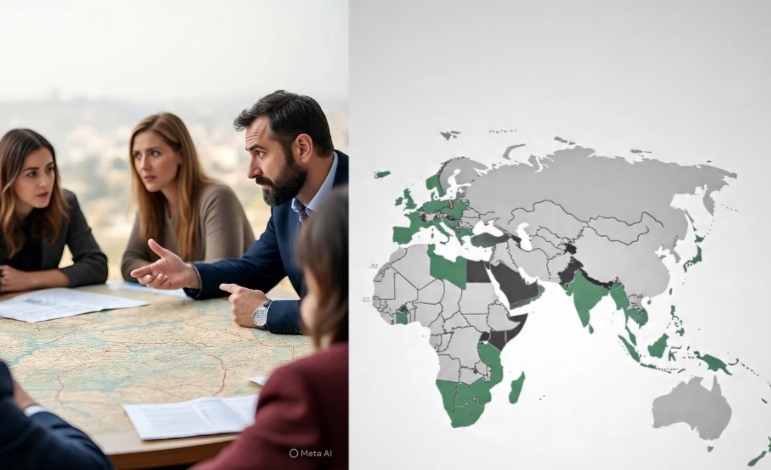
The idea of “Greater Israel” itself has several interpretations. In religious literature, particularly the Hebrew Bible, references are made to a land promised to the descendants of Abraham, sometimes symbolically described as stretching from the Nile River to the Euphrates River. Some interpret these passages as suggesting a vast territorial vision encompassing parts of present-day Egypt, Jordan, Syria, Lebanon and Iraq.
Most historians, however, view these descriptions as religious or historical references rather than modern political boundaries. During the early twentieth century, the Zionist Movement considered various territorial possibilities but ultimately focused on establishing a state in part of historic Palestine. This process culminated in the establishment of Israel in 1948 following the 1948 Arab–Israeli War.
In contemporary discourse, the phrase “Greater Israel” is used in different ways. A small minority of religious-nationalist groups believe that the entire land between the Jordan River and the Mediterranean Sea should belong to Israel. Critics sometimes interpret Israeli settlement expansion in the West Bank as evidence of a broader territorial project. Supporters of Israel, however, argue that these policies are shaped mainly by security concerns and complex political negotiations.
Israeli governments have also entered peace agreements with neighboring countries, including the Egypt–Israel Peace Treaty of 1979 and the Israel–Jordan Peace Treaty of 1994. These agreements illustrate that regional diplomacy has often involved compromise rather than territorial expansion.
Ultimately, the phrase “Greater Israel” carries multiple meanings: a religious description found in scripture, a political aspiration held by a small ideological fringe and a term used by critics to interpret Israeli policies. It is not an officially declared expansion plan of the Israeli government. At the same time, the presence of a significant Muslim minority, the operation of hundreds of mosques and continued worship at sites such as Al-Aqsa highlight the complexity of the situation and caution against overly simplistic conclusions about the fallacious concept of “Greater Israel.”