 Dr. A. K. Merchant*
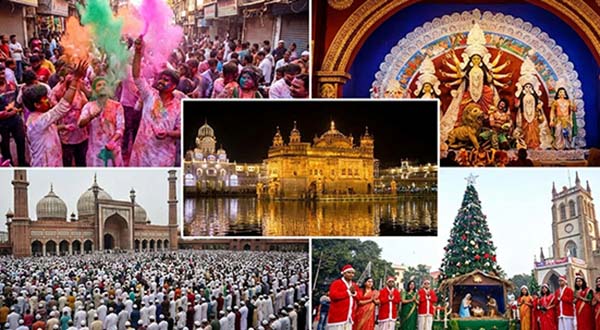
India is a land of religious celebrations all the year round given the vast diversity and centuries’ old traditions. It is not surprising that all the religions aka dharma contributes substantially to the domestic market-economy providing sustenance to billions in the country and elsewhere. From October of the current year onwards the Holy Days are celebrated or commemorated; new year dates keep appearing until April of the next year according to different calendars.
As an interfaith activist and member of the Bahá’i Faith, I believe that all religions aka dharma come from the same Divine source. Hence, I enjoy the spirit of every Holy Day whether it be solemn or joyful. For, the Bahá’i Writings remind us: “To be a Baha’i simply means to love all the world; to love humanity and try to serve it; to work for universal peace and universal brotherhood.”
From ancient times, all over the world, people have recognized the importance Winter Solstice, an astronomical occurrence. It is celebrated as the successive “return” of the Sun in a variation of different ways with accompanying rituals by different communities, whether religious or secular. No wonder, astronomy and its corollary astrology, are integral beliefs of the Hindu faith-based traditions commemorated throughout the country and identified in the many Hindu calendars: Shalivahana Saka, Vikram Samvat, Tamil Calendar Malayalam Calendar, Saka Samvat and others. A few Holy Days do follow the solar calendar and are based on the signs of the zodiac. For example, Makar Sankranti, celebrated across India, marks the entrance of the Sun into the sign of Capricorn, as does the Tamil Holy Day of Pongal. A few regions in India base their New Year observances on the entrance of the Sun into the sign of Aries—an occurrence called Mesha Sankranti—such as Vishu in Kerala, Puthandu in Tamil Nadu, Pohela Boisakh in Bengal, Bihu in Assam, and Vaisakhi in Punjab. Otherwise, the dates of most Hindu festivals are determined according to the lunar calendar of the months.
While in the Western tradition there are holidays such as Hanukkah celebrated by the Jewish Community for eight days and Christmas (adopted from the Roman Sun Festival tradition) by Christians followed by New Year as incorporated in the Julian and Gregorian calendars. Followers of these religious communities gather at their places of worship for ritual worship and fellowship meals. Zoroastrians and Bahá’ís celebrate Naw-Ruz, coinciding with Spring Equinox. Likewise, there festive days of the Buddhists, Jains, Sikhs, and faith-based traditions in the countries of south-east and far-east.
There is rich beauty to be found in all the celebrations, and from the viewpoint of the Bahá’i Faith a tangible expression of humanity’s common oneness. Bahá’ís come from all backgrounds and unequivocally accept and recognize the Founders of all the world’s great religious systems. However, in keeping with the principle governing the gradual unfoldment of civilizational history, the Bahá’i Faith offers a new calendar comprising of 19 months of 19 days and some intercalary days.
Bahá’ís believe that as humanity marches onward to its maturity, this new calendar would be adopted and it would symbolize the power of Divine Revelation to reshape human perception of material, social, and spiritual reality. Through this calendar sacred moments and sacred time would be reimagined, and the rhythm of life recast. It would serve as a major historic turning point, that in tandem with several other spiritual happenings, mark the unfoldment of a new World Order, synonymous with the emergence of Ram Rajya and establishment of the Kingdom of God on earth, as per the belief systems of diverse human race.
Therefore, no matter which Holy Day an individual may observe, it is important to keep in mind its spiritual significance. The spirit of joyful camaraderie, of gratitude, and acts of charity mindful of the less fortunate. For, our worship is directed towards the same one loving Creator, invoked in different ways, in different languages, at different places. This would be the best demonstration of our humanity and acceptance of Vasudhaiva Kutumbakam—One planet, One Family, One Future. “O contending peoples and kindreds of the earth!,” Bahá’u’lláh wrote, “Set your faces towards unity, and let the radiance of its light shine upon you. Gather ye together, and for the sake of God resolve to root out whatever is the source of contention amongst you. Then will the effulgence of the world’s great Luminary envelop the whole earth, and its inhabitants become the citizens of one city, and the occupants of one and the same throne.”
————————————–
*The author is a social worker, independent researcher, & member of the Bahá’i Community of India. Views expressed are personal.