 Dr. A. K. Merchant*
With the start of a new year of the Gregorian calendar the question before every concerned citizen whether in India or elsewhere is whether humanity can envision a future where human beings remain the primary unit of life. Disruptive technologies such as Artificial Intelligence are overtaking the lives of a vast majority making one wonder, rather bewildered, awed, and even paralyzed. Mindful of the looming catastrophes, followers of Bahá’u’lláh, Founder of the Bahá’i Faith, reinforce their convictions that His call for a united humanity is not an idle utopia but a practical, transformative vision. Within just a few decades since its public proclamation, His teachings spread worldwide, taking root across cultures and nations influencing millions. Its power lies not in rhetoric alone but in its capacity to reshape hearts, minds, and the course of history.
There are prophetic scriptural texts that would convince the followers of all religious communities that this is the Age when a unified human family can emerge, as foreseen by the Spiritual Luminaries of a bygone era. Sacred texts from the Hindu Scriptures to the Qur’án and the Bible and the Writings of Bahá’u’lláh all point toward a time of moral awakening and collective reformation:
Hinduism: “By his irresistible might he will destroy all the barbarians and thieves, and all whose minds are devoted to iniquity. He will then re-establish righteousness upon earth; and the minds of those who live at the end of the Kali Age shall be awakened, and shall be as pellucid as crystal. The men who are thus changed by virtue of that peculiar time shall be as the seeds of human beings, and shall give birth to a race who shall follow the laws of the Krita Age, the Age of Purity.” (Vishnu Purana 4.24). “Whenever there is a decay of righteousness (Dharma), O Bharata, and a rise of unrighteousness (adharma), then I manifest Myself. For the protection of the good, for the destruction of the wicked and for the establishment of righteousness, I am born in every age.” (Bhagavad-Gita 4:7-8)
Christianity: “In that day, saith the Lord of hosts, shall ye call every man his neighbour…” Zechariah 3:10. “But there is going to come a time of testing at the judgment day to see what kind of work each builder has done. Everyone’s work will be put through the fire to see whether or not it keeps its value. If the work survives the fire, that builder will receive a reward. But if the work is burned up, the builder will suffer great loss.” 1 Corinthians 3:13–15
Islam: “Our Lord! For the day of whose coming there is not a doubt, thou wilt surely gather mankind together. Verily, God will not fail the promise.” Qur’án 3:7.
Bahá’í Faith: “How vast is the tabernacle of the Cause of God! It hath overshadowed all the peoples and kindreds of the earth, and will, ere long, gather together the whole of mankind beneath its shelter.” (Bahá’u’lláh, Tablet of the World, para 3).
These are just a few quotations that should reinforce the conviction that global unity is both foretold and attainable. In fact, such prophetic statements are there in the Scriptures of other religions but paucity of space for a short article is only constraint.
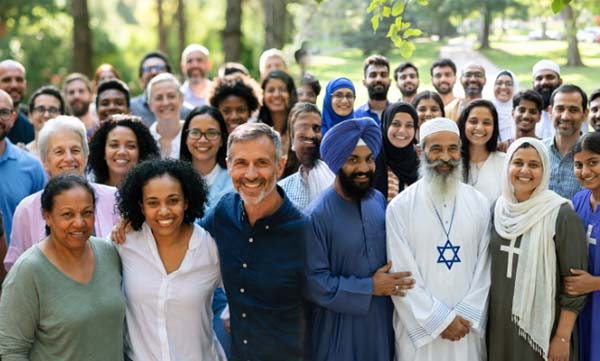
A new worldview is called for on the part of leaders, both secular and religious, as well as the generality of humankind because progress toward a cohesive global society requires abandoning mechanistic metaphors that reduce people to isolated parts. Instead, they must embrace an organic vision of social change that transforms institutions and human consciousness alike. Through successive Plans that embrace the entire societies, the Bahá’ís wherever they reside endeavour to reconcile competing creeds, ethnicities, and nations through spiritual principles and practical institutions rooted in the authority of its Founder and the guidance from its global governing council—The Universal House of Justice.
There is a global pathway for the transformation of the present-day, fragmented and highly volatile world. The Bahá’í model advances society through three interlinked steps: (i) Strengthening the individual by meeting needs and inspiring higher aims. (ii) Fostering world-mindedness so people see themselves as part of a common destiny. (iii) Directing collective effort toward building a universal civilization that cultivates individual potential while enriching the social whole. When individuals, communities, and institutions align, they create a single, shared purpose that propels civilization forward.
There is no room for negativity, and every moment is right, Bahá’ís “increasingly appreciate the privilege of being able to acquaint every receptive soul with the mission of Bahá’u’lláh—and, beyond to lend their support in whatever manner possible in the spiritual journey.
Humanity stands at a turning point: social interdependence and global challenges make a planetary social order both necessary and possible. Contemporary culture often emphasizes short-term gains and superficial images, yet thinkers like Ervin Laszlo, Louis Pasteur, and Albert Einstein urge a broader perspective—one that widens compassion and channels human ingenuity toward constructive ends. The time is ripe for a renewed commitment to peace, cooperation, and moral progress.
For the Bahá’ís the planet is our common homeland, and all human beings one people. Conflicts and wars for control of territories or re-aligning borders and creating divisions are ultimately reflections of the immature mind and manifestations of a spiritually impoverished soul. Transformation may begin with awareness and understanding the reality of the happenings and crises surrounding peoples and societies. One must constantly expand his or her circle of concern. Bahá’u’lláh’s message—that the earth is one country and humanity its citizens—offers a practical framework for building a world in which diversity is preserved and unity is realized. Embracing this vision calls for moral courage, institutional innovation, and a shared resolve to carry forward an ever-advancing civilization. There is convergence because His message, Bahá’ís believe to be from the one Supreme Divinity Who gave the Ten Commandments, the Gospels, the Qur’an, Who spoke through Sri Krishna, Zoroaster, Mahavira, Buddha and Guru Nanak, and Who now, as humankind moves towards maturity, brings to fulfilment all the strivings and promises of the past.
————————————————–
*The writer is a social worker, independent researcher, & member of the Bahá’i Community of India. Contact <akmerchant@hotmail.com>. Views expressed are personal.