 Dr. A. K. Merchant*
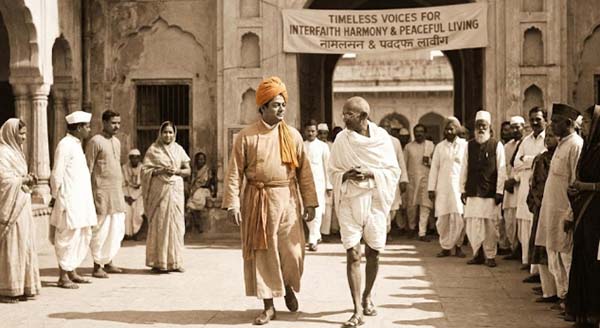
As we reflect on the global scenario, the state of the nation, the city, the village, and our immediate neighbourhood, among the many outstanding personalities born in January, for us in India—Swami Vivekananda (1863-1902) and Mahatma Gandhi (1869-1948) are the most outstanding—one is celebrated and the other is commemorated. Vivekananda’s birthday, 12th January, is celebrated as the National Youth Day whilst Gandhi ‘s date of assassination, 30th January, is commemorated as Martyr’s Day. Both these great souls are precious trailblazers for interfaith harmony. They did so much for the betterment of society of their times. They inspired and mobilized millions to tread the path of goodness and provide welfare to the less fortunate and disadvantaged sections of the population. For me as a member of the Bahá’í Faith, although Gandhi ji was acquainted with some of the well-known Bahá’ís of his times, and is reported to have said, “Bahá’í Faith is a solace to mankind”; there is no documented evidence whether Swami Vivekananda encountered any members of the Baha’i Community during his lifetime. However, in later years a number of Bahá’ís associated with Ramakrishna Mission accepted the Faith in realization of the fulfilment of the prophecies in Hindu Shastras.
Both Swami Vivekananda and Mahatma Gandhi offered powerful, complementary models for interfaith harmony: Vivekananda presented Hinduism as a universal spiritual path and argued that all religions are valid routes to the same ultimate Reality, while Gandhi practiced equality of religions (sarva-dharma-samanatva) and translated interfaith principles into civic practice—nonviolence (ahimsa), truth (satya), and communal cooperation were central to his public life. Gandhi insisted that no religion has a monopoly on truth; each contains partial truths that together enrich human understanding. From the Bahá’i viewpoint this corroborates the belief that religion or dharma is one; it is progressive and continuous. Both lived at a time when teeming millions in the Indian sub-continent were trapped in the throes of acute suffering, widespread poverty and many forms of deprivation for their day-to-day survival. Vivekananda championed a universal religion that recognizes the essential unity of all faiths and the divinity within humanity; his Chicago addresses and writings urged tolerance, spiritual renewal, and service as foundation for national progress. These echo the teachings of unity in diversity, acceptance of the ‘other’, the need for spiritual renewal of humanity, and freedom of peoples from prejudices and distorted interpretations of religious teachings transcending the limiting identities of race, caste, creed, class, and gender. Vivekananda’s appeal to the youth is especially very pertinent: “My hope of the future lies in the youths of character—intelligent, renouncing all for service of others and obedient…” for achieving the lofty objectives of a Viksit Bharat. “Arise! Awake! And stop not until the goal is reached.” “Believe in yourself and the world will be at your feet.” Even a cursory reflection on his speeches can energize vast numbers and inspire them to focused actions.
On the other hand, Gandhi ji was successful in mobilizing the masses embracing the cross section of the Indian society to overthrow the colonial powers that had fettered much of the population into a state of passive complacency. Gandhi ji’s emphasis on nonviolence (ahimsa), truth (satya), and service (seva) to the poor, resonates with the manifold activities for addressing the grave crises that appear to engulf the masses across the globe although in recent decades India has registered great success in lifting a significant number from the state of absolute poverty.
Both Swami Vivekananda and Mahatma Gandhi remain powerful moral exemplars for millions of interfaith practioners as witnessed at the Parliament of the World’s Religions: Vivekananda for his universalist spiritual vision and appeal to youth, and Gandhi for his mass‑mobilizing ethics of nonviolence and service—each echoing core Bahá’í principles of unity, justice, and social transformation. Let me flag three important issues: (i) Unity of religion: Vivekananda’s insistence that all religions point to the same truth parallels the Bahá’í teaching of the oneness of religion and the progressive revelation of spiritual truth. (ii) Service and justice: Both leaders prioritized service to the poor and moral transformation of society, aligning with Bahá’u’lláh’s emphasis on social welfare and the elimination of extremes of wealth and poverty. (iii) Practical spirituality: Gandhi’s lived example shows how spiritual principles can be institutionalized into social movements; Vivekananda shows how spiritual education can energize youth and intellectual life—both are critical for attaining sustainable living, “without being swept off course by world’s unabating distractions”.
A word of caution, promoters of interfaith harmony must avoid tokenism, i.e. symbolic gestures without structural cooperation; meaningful interfaith work requires shared decision-making and accountability. Because, Vivekananda and Gandhi are complementary guides: one rekindles the inner spiritual fire and universal outlook; the other demonstrates how that fire can be channeled into collective, nonviolent transformation of society. A reminder for all of what Bahá’u’lláh asserted more than one-and-half century ago: “All people have been created to carry forward an ever-advancing civilization,” a core Bahá’í principle emphasizing humanity’s spiritual and material progress, requiring virtues like forbearance, mercy, and love, and stressing sustainable development for an emerging new World Order. This means individuals and communities should strive for personal growth (knowledge, wisdom, spirituality) and contribute to society’s betterment, moving beyond base instincts towards a more advanced, unified global civilization.
—————————————————-
*The writer is a social worker, independent researcher, and member of the Bahá’i Community of India. Views expressed are personal.