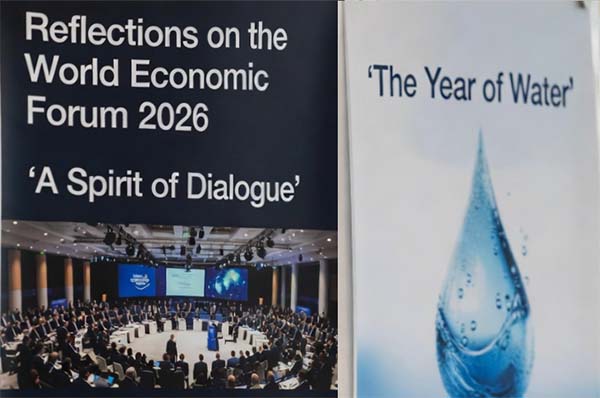
Reflections on the World Economic Forum 2026—‘A Spirit of Dialogue’ & ‘The Year of Water’
 Dr. A. K. Merchant*
The modern individual is inundated daily with media and messages, yet only a few pause to reflect on humanity’s deepening crises: widening inequality, discrimination, crime, and exploitation. Bahá’u’lláh, Founder of the Bahá’i Faith, observing the state of world of His times and foreseeing the future conditions, wrote, in the Tablet of the World: “The world is in great turmoil, and the minds of its people are in a state of utter confusion. We entreat the Almighty that He may graciously illuminate them with the glory of His Justice, and enable them to discover that which will be profitable unto them at all times and under all conditions.” This is so prophetic. With that in mind, this short article reflects on the 56th World Economic Forum in Davos-Klosters (19–23 January 2026), convened under the theme “A Spirit of Dialogue” and designated the “Year of Water.” The summit gathered roughly 3,000 leaders—about 60 heads of state and government and numerous CEOs—to confront urgent global challenges under four broad headings: (i) new deals and dynamics; (ii) a reckoning for humanity; (iii) the tangible effects of dialogue; (iv) and living with unresolved questions.
The Universal House of Justice, supreme governing council of the Bahá’i Faith, and its United Nations affiliate, the Bahá’í International Community regularly address global concerns, contributing thought and action toward the betterment of the world. As the Bahá’í community prepares for the next phase of its Nine-Year Plan (2022–2031), followers are called to respond to worsening global conditions that demand collective attention. The Bahá’í conviction that the welfare of any part of society is bound to the welfare of the whole underpins this engagement and renewed spirit of devotion and dedication. When sections of population and nations pursue their own interests in isolation or prioritize profits, and neglect of environmental stewardship, everyone loses. Persistent greed and self-interest, and the resulting concentration of wealth, create instability and injustice that cannot sustain the population of 8+ billion. Such forms of development and economic activity should be urgently remedied.
Speakers at World Economic Forum highlighted the urgency of confronting the world as it is rather than waiting for an idealized future. Leaders debated energy, trade, immigration, and economic growth, and warned against protectionism and unilateral force. The summit’s discussions echoed themes long present in Bahá’í writings: the collapse of outdated treaties—bilateral or multilateral and the need for new structures grounded in justice and equity. The Bahá’í perspective holds that the world’s vast resources—global GDP estimated at roughly USD 120 trillion in 2024–2025—could, if distributed fairly, eliminate extreme poverty. This vision challenges assumptions that unrestrained self-interest is the engine of progress and insists that wealth must serve humanity rather than define human worth. In essence the voices from Davos repeatedly emphasized that business as usual was unacceptable, and reinforced the need for justice among the comity of nations and the corporates for the survival of humankind.
Bahá’u’lláh does not prescribe a detailed economic system, yet His teachings emphasize the reorganization of society and the spiritual reality of humanity. The Bahá’í view affirms the inherent nobility of every person and sees economic life as a field for expressing honesty, integrity, generosity, and service. Every individual is urged to consecrate oneself to the service of others rather that promoting one’s personal interest. One finds meaning and purpose in life when upliftment of society becomes an integral aspect of day-to-day living. Viewed in this light, many seemingly ordinary economic activities gain new significance because of their potential to add to human welfare and prosperity. The poor are urged by Bahá’u’lláh to “exert themselves and strive to earn the means of livelihood”, while they who are possessed of riches “must have the utmost regard for the poor”. Elsewhere, in the Bahá’i writings it is stated: “Wealth is praiseworthy in the highest degree, if it is acquired by an individual’s own efforts and the grace of God, in commerce, agriculture, art and industry, and if it be expended for philanthropic purposes.” Spiritual principles for a just and fair economic life should be the norm.
Materialism’s seductive messages foster self-centeredness and blindness to widespread hardship of vast multitudes of vulnerable populations. Bahá’ís counter these influences through educational programs that nurture spiritual awareness and social responsibility: devotional gatherings, moral education for children, and spiritual empowerment activities for junior youth. Bahá’í Training institutes cultivate qualities that help individuals resist materialistic impulses and align their daily lives with spiritual principles. Over time, study of Sacred Texts and their practical implications raises consciousness about managing material affairs in ways that reflect Divine teachings. Thus, education, moral formation, and resistance to materialism should permeate development and economic services.
The widening chasm between wealth and poverty, together with other forms of exploitation, undermines the rules-based international order and exacerbates environmental and social crises. The Bahá’í vision for a future world order foresees coordinated use of resources, equitable distribution of goods, and the redirection of energies from conflict toward human advancement: scientific research, public health, education, and the refinement of human capacities. As Bahá’ís work to apply these teachings, they urge leaders and citizens everywhere to answer the fundamental questions of identity, purpose, and conduct. Knowing who we are and why we exist must lead to practical changes in behaviour that gradually transform society. It is towards this goal, the goal of a new global order, equitable in principle, challenging in its features that a harassed humanity must strive.
The Bahá’í approach rejects quixotic campaigns to eradicate every evil in isolation. Instead, it calls for sustained, collective effort to build institutions and habits that foster justice, unity, and the flourishing of all humanity. When that process gains momentum, destitution and gross accumulation will fade, and human creativity and resources will be devoted to elevating the intellectual, moral, and spiritual life of the entire race.
—————————
*The writer is a social worker, independent researcher, & member of the Baha’i Community of India. Views expressed are personal.