
 Dr. A. K. Merchant*
The awesome uncertainties and mind-boggling changes brought about by happenings and events of the 20th and 21st centuries coupled with a host of interrelated crises threaten both the fabric of civilized life and the natural world itself. The Writings of the Bahá’i Faith state: “Our world has entered the dark heart of an Age of fundamental change beyond anything in all of its tumultuous history. Its peoples, of whatever race, creed, religion, caste, class, nationality and religion, are being challenged to subordinate all lesser loyalties and limiting identities to their oneness as citizens of a single planetary homeland…” Creating conditions of socio-politico and economic equity, and patterns of living that are harmonious and progressive represents a fundamental challenge to all of the globe’s inhabitants. It is a challenge that confronts all three protagonists that constitute society—individuals, communities, and institutions.
Nowhere is the crisis more acute than in the systems of present-day governance, in almost every sovereign nation-state. As per past records India could be considered the cradle of democracy. The concept of Dharma from Vedic times, which encompasses multiple duties, laws and sociality, emphasises social order and equitable conduct while promoting democratic practices. It is noteworthy that in ancient India, there was a focus on village panchayats and self-governing bodies. Their structure and operation influenced the development of democratic institutions. The teachings of Buddhism and Jainism contributed to democratic values by emphasising non-violence, equality and consent in governance. The Bhakti movement’s emphasis on equality and forging a direct relationship with the Divine further spread democratic consciousness among the masses. This tradition gained enduring spirit during India’s struggle for independence and further shaped India’s understanding and commitment to democratic principles in the postcolonial era. The reign of the Maurya Emperor Ashoka saw rule influenced by Buddhist ideals, which emphasised the ruler’s responsibility for the welfare of his subjects. However, the parliamentary system in its modern connotation owed its origin and growth to India’s British connection for some two centuries.
The Indian Independence Act, 1947, provided for the setting up of two dominions of India and Pakistan with effect from 15th August 1947. The Founding Fathers of the Constitution chose the system of representative parliamentary democracy with universal adult franchise. Freedom brings responsibility. Building on the traditions of the national movement, Indian leaders strengthened the foundations of democracy in the country by the manner of their functioning. They not only gave due importance to the institutional aspects of the democratic institutions and procedures but also the spirit.
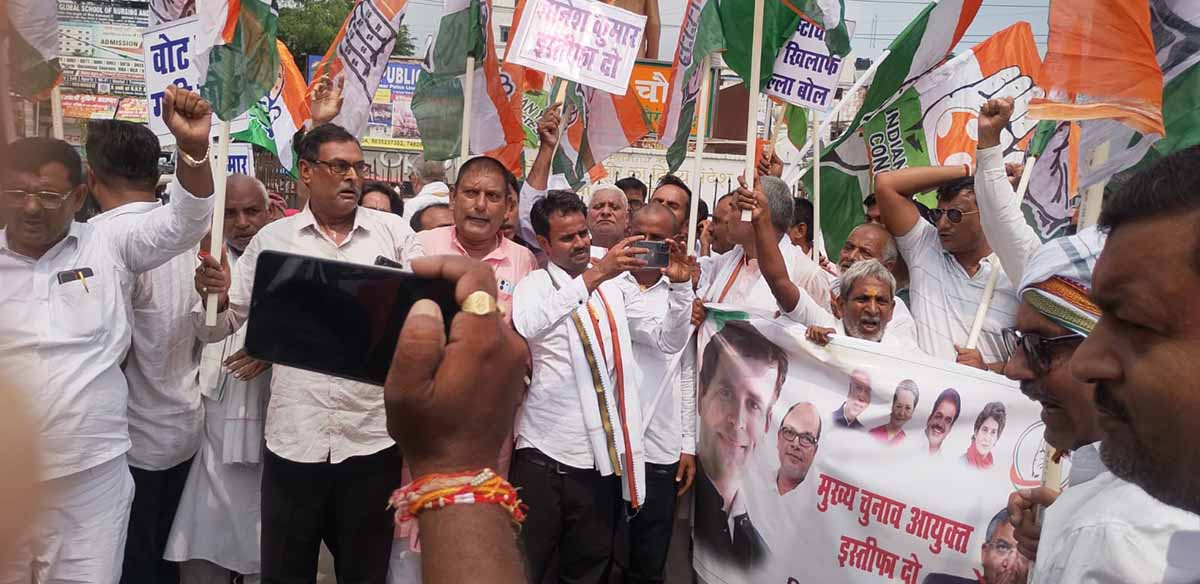
From an electorate of 173 million in 1951 when India went to the polls for the first time under the Constitution, the number of electors swelled to nearly 672 million in 2004 and 980 million in 2024. The fair and peaceful conduct of elections periodically with a large turnout of voters, especially of the rural folk and women, and the participation of all groups with different ideology and religious faith, is an indication of the acceptance of the framework of the Constitution and the growing political awareness among the people. These elections have demonstrated that the democratic urge is very deep-rooted among the peoples of India and their faith in a constitutional system of government is very strong albeit occasional turmoil.
If we are to live in peace and happiness, every nation, community, and the individual must envision universal and humanitarian ideals and must strive to practise them in thought, speech and action. Governance must be founded on moral and spiritual fundamentals. In ancient India, politics was regarded as a branch of ethics. Peace, justice and liberty for all were the prime purposes of governance.
The expectation at the time of Independence was that public servants would sacrifice their personal interest for public welfare has not been fulfilled. Mahatma Gandhi did not want the constructive workers, men and women who had directed the several organisations over the years to remove untouchability, extend basic education, improve food cultivation, develop village industries and encourage hand spinning, to go into party politics or crave for positions of power. That would, he felt, vitiate the spirit of harmony among all sections of the population. However, most of the leaders disagreed and political parties became the mainstay for the governance of independent India.
Democracy is at stake if the loudest voice counts as the voice of wisdom or when coercive pressures take the place of reason and persuasion. The success of democracy demands a better share of resources, autonomy and self-government.
The approach of the Bahá’i Community to the reformation of the governance systems, is to create a new model, currently described as the Bahá’i Administrative Order which is being laboriously erected under the guidance of the Universal House of Justice, the supreme governing council of the Faith. In most countries the electoral processes are being discredited due to “endemic corruption,” the influence of “lavish funds,” and “media bias.” Instead of partisan politics which the members of the Bahá’í community strictly abstain from because it is considered damaging to the unity and spiritual character of the Faith, Bahá’ís are urged to focus on community building, acting as “constructive agents of change” by fostering unity and moral, social, and economic development, and presenting its consultative institutions as an alternative model. This guidance reinforces the Bahá’í principle of remaining “aloof from party politics,” focusing instead on moral and spiritual transformation. As loyal citizens of the country wherever the Bahá’ís live, they exercise their franchise of citizenship and participate in social and civic activities without aligning with political parties or participating in political manoeuvring
There is ample guidance in the Bahá’i Writings on reforming the overall infrastructure for promoting and sustaining peace. This would enable familiar patterns of acrimonious blame game, oftentimes causing a paralysis in decision making in the Parliaments or the State Legislative bodies, to give way to a more decisive response in the interest of the entire society and the nation. In the Bahá’i institutions there is no scope for deadlocks or conflicts. Decisions are made through a general consensus for the purpose of common good and for winning acceptance and legitimacy. The system of Bahá’i Administration is a work in progress that offers a tangible model for replacing the present-defective systems of governance. To the degree that today’s warring societies are willing to make improvements and meaningfully contribute their share to a process of growth and development of their respective nations to that degree the impact of positive transformation would become evident.
As nation states come to grips with Bahá’u’llah’s clarion call: “The world is but one country, and humankind its citizens”, and elsewhere: “The well-being of humanity, its peace and security are unattainable, unless and until its unity if firmly established,” they would gradually commit themselves to build, rather, rebuild their countries. Distrust, violence and corruption would give way to peace and good governance. For example, where the equality of women and men has been infused into every facet of social life—decision making improves; there is more judicious distribution of resources.
Progress toward the goals enshrined in national and global agendas therefore calls for a conscious orientation toward experimentation, search, innovation, and creativity. As these processes unfold, the moral framework and practical model evolved by the Bahá’i Community, would play a transforming role. Respect for the laws of the land, upholding fundamental human rights, adherence to legislations passed by the Parliaments become easier to implement. A higher standard of integrity and trustworthiness would be inculcated among the generality of the population. Without such an approach, in my personal view, no amount of administrative reorganization will resolve the host of long-standing challenges before us and good governance would remain an elusive goal.
________________________
*The writer is a social worker, independent researcher, & member of the Bahá’i Community of India.