 Najmuddin A. Farooqi.
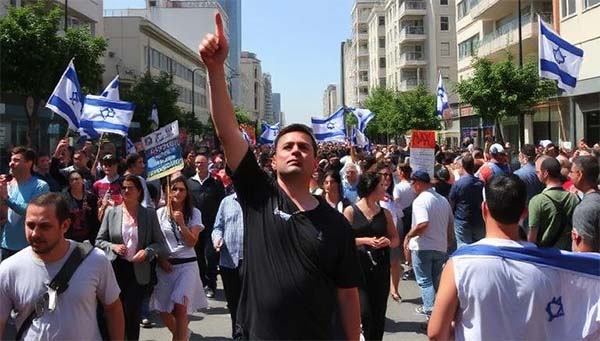
In recent months, the streets of Tel Aviv have become a powerful example of democratic expression in action. Citizens majority of them Jewish Israelis have gathered openly and without fear to raise their voices. These are not outsiders or distant critics, but people from within the country itself, questioning their own government and its policies during a time of war.
On May 1, 2026, thousands of protesters marched through central Tel Aviv as part of a May Day demonstration. Carrying red flags and banners, they voiced opposition to the war and called for justice and accountability. Some placards carried strong and emotional messages such as Stop genocide in Gaza, reflecting deep concern over the humanitarian situation. The following day, smaller gatherings of around 1,000 to 2,000 people continued the protests at Habra Square. In late April an estimated 1 lac people (1% of total population of Israel) gathered at a widely known “Democracy Square” that has become the heart of large scale demonstrations in Israel. This massive demonstration was part of a series of weekly protests that have intensified as public dissatisfaction with Prime Minister Benjamin Netanyahu’s government.
What stands out is not only the size of these protests but the space allowed for them. Even during wartime a period when many governments tend to tighten control people have been able to assemble, express dissent and challenge their leaders. There have been no widespread reports of violent crackdowns or systematic suppression of these protests. Instead, citizens are seen exercising a fundamental democratic right the freedom to speak and to disagree.
This raises an important question for societies everywhere can a nation truly call itself strong if it silences its own people ? Or does real strength lie in allowing dissenting voices to be heard, even when they challenge those in power ?
The protests in Israel also reflect a deeper internal debate about the country’s direction, identity and policies. Intellectuals and scholars within Israel have contributed to this discussion. For example, an eminent scholar, author and historian Omer Bartov in an interview in April 2026, expressed serious concerns about the current trajectory of Israeli policy and ideology. While affirming his connection to Israel, he argued that certain political and ideological developments have moved in troubling directions, raising moral and humanitarian questions.
Bartov’s views are part of a broader conversation taking place within Israeli society one that includes disagreements about history, security, ideology and the future of the state. Importantly, such debates are happening publicly, involving academics, activists and ordinary citizens alike. This openness, even when the discussions are deeply uncomfortable or controversial, is a hallmark of a functioning democracy.
The presence of large scale protests, critical voices and open debate does not mean a society is without problems. On the contrary, it often highlights deep divisions and serious challenges. However, it also shows that there is space to confront those challenges openly.
Israel’s current moment demonstrates that democracy is not just about elections or institutions it is also about the willingness to tolerate disagreement and to allow citizens to question authority. The scenes from Tel Aviv serve as a reminder that democratic strength is not measured by uniformity of opinion, but by the ability to accommodate difference.
At a time when many parts of the world are grappling with restrictions on free expression, the sight of people protesting openly even during conflict offers an example worth reflecting on. Whether one agrees or disagrees with the views expressed, the ability to express them remains essential.
In the end, the real test of any democracy lies not in how it treats those who support the government, but in how it treats those who challenge it.