 Najmuddin A. Farooqi.
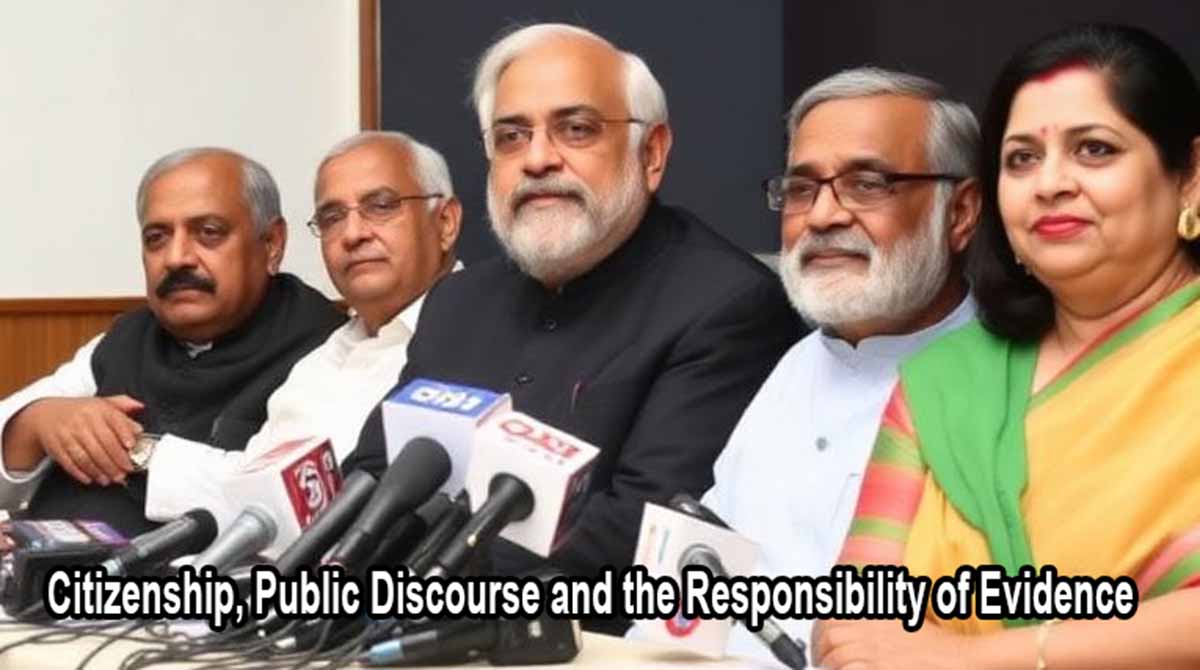
Yesterday I listened to a distinguished panel comprising former Election Commissioner Ashok Lavasa, Justice (Retd.) Madan B. Lokur, political scientist Professor Niraja Gopal Jayal and social activist Anjali Bhardwaj. They addressed an audience on the theme of “Citizenship” as part of the conclave on “One Nation–One Election, Federalism and Citizenship”, organised by the Constitutional Conduct Group and the Group on Federalism & Elections.
The discussion was intellectually stimulating and thought-provoking. However, it also prompted me to reflect on certain questions that deserve equal attention in any democratic debate.
I write neither in defence of the government nor in opposition to it. My purpose is not to take sides but to present an evidence-based and balanced perspective. As a citizen, I have consistently exercised my right to question government policies wherever I believed such scrutiny was warranted. Equally, I believe citizens have the same right and indeed the responsibility to ask reasonable questions of those who oppose government policies. Democracy flourishes not through unquestioning support or reflexive opposition but through informed and reasoned debate.
Unfortunately, our public discourse has increasingly become polarised. On one hand, the ruling establishment is often accused of pursuing policies perceived as appeasing the majority, thereby deepening anxiety among sections of minorities. On the other hand, a section of civil society frequently interprets almost every governmental action through the lens of communal victimhood. Between these competing narratives, the Indian Muslim often becomes the symbolic focal point sometimes as the target of hostility and at other times, as the object of excessive political sympathy.
My concern is that in this process, genuine issues of education, employment, healthcare, economic development and social progress are overshadowed by emotionally charged narratives. Rhetoric gradually replaces evidence and perception begins to outweigh reality.
Among all the issues debated in independent India since the Ram Janmabhoomi movement and the demolition of the Babri Masjid, perhaps no subject has occupied the national political discourse as persistently as citizenship. Since 2014, opposition parties and sections of civil society have repeatedly linked citizenship with the National Population Register NPR, the National Register of Citizens NRC, the Citizenship Amendment Act CAA, the recent Special Intensive Revision SIR of electoral rolls and more recently, the controversy relating to passports.
The language employed in many such debates has often been exceptionally grave, invoking expressions such as “genocide”, predicting that Indian Muslims would become second-class citizens, lose their voting rights, or even be stripped of their citizenship. Such claims deserve careful examination because words of this magnitude should rest upon demonstrable evidence rather than apprehension alone.
Historical context is equally important. The tightening of India’s citizenship law did not begin in 2019. The Citizenship Amendment Act, 1986, enacted by the Rajiv Gandhi government and effective from 1 July 1987, fundamentally altered citizenship by birth, moving India from a predominantly jus soli citizenship by place of birth approach towards a more restrictive framework incorporating elements of jus sanguinis citizenship by descent. The Assam Accord of 1985 gave rise to the special provisions embodied in Section 6A of the Citizenship Act, specifically addressing the unique circumstances of Assam.
Likewise, the legal challenge surrounding Assam was not initiated by the present government. Petitions questioning the implementation of the Assam Accord and the constitutional validity of Section 6A were filed before the Supreme Court in 2009 and subsequently in 2012, several years before the present government assumed office. The NRC process in Assam was ultimately carried out under the direct supervision of the Supreme Court.
The publication of the final NRC list on 31 August 2019 also altered several political assumptions. Many had anticipated that the exclusions would overwhelmingly affect Assamese Muslims. Instead, the final list demonstrated a far more complex reality, with significant numbers of non-Muslims also excluded. This underlined an important lesson: facts often differ from political expectations.
Against this background, I respectfully place a few questions before the eminent speakers and others engaged in the citizenship debate.
The Citizenship Amendment Act was enacted in December 2019. Nearly eight years have now passed. How many individuals have actually been granted Indian citizenship under this law? If citizenship has indeed been conferred upon eligible non-Muslim refugees from the specified neighbouring countries, in what concrete manner has this affected the citizenship of any Indian Muslim? More importantly, how many Indian Muslims have lost their Indian citizenship because of the CAA during the past twelve years?
Similarly, while the prospect of a nationwide NRC has repeatedly been debated, no nationwide exercise has commenced. Apart from one statement made by the Union Home Minister which was later clarified the government has not initiated such a process. Even assuming that such an exercise were undertaken in the future, on what basis can it be concluded that only Indian Muslims would be affected? Would documentary deficiencies not affect citizens belonging to every religion and community?
The recent passport controversy also deserves scrutiny. Passports are possessed by only a small proportion of India’s population of over 140 crore. Moreover, the Citizenship Act itself does not designate a passport as the sole or conclusive proof of citizenship. Is it therefore proportionate to suggest that changes in passport-related procedures would fundamentally determine the citizenship status of Indian Muslims? Or has this controversy diverted attention from more substantive issues?
The Special Intensive Revision SIR of electoral rolls presents another example. I am not defending the exercise, particularly if it is used as a political instrument or implemented without adequate safeguards. Electoral roll revisions must always be transparent, fair and subject to judicial scrutiny. However, it is equally important to distinguish between electoral registration and citizenship. Deletion from an electoral roll, whether correct or erroneous, does not automatically extinguish citizenship.
Indeed, errors have affected individuals across communities. I personally assisted an octogenarian retired senior Railway officer from Lucknow, belonging to an upper-caste Hindu family and his wife, whose names had been omitted from the electoral rolls despite their impeccable credentials. Their names were subsequently restored. Their daughter and son-in-law both serve as Additional Chief Secretaries. This experience illustrates that administrative errors, while serious, are not necessarily targeted on the basis of religion alone.
None of this is to suggest that discrimination can never occur. Wherever there is credible evidence of injustice against any citizen whether Muslim, Hindu, Christian, Sikh or any other community it deserves immediate attention and effective legal remedy. Democratic vigilance is indispensable.
At the same time, every administrative lapse or policy disagreement should not automatically be interpreted as a deliberate attempt to dispossess an entire community of its citizenship. Such conclusions require compelling evidence. Otherwise, repeated alarm without substantiation risks weakening the credibility of genuine human rights concerns.
The citizenship debate must therefore be guided by constitutional principles, historical context and verifiable facts. Fear should not replace evidence, nor should political rhetoric eclipse constitutional reasoning. Our collective responsibility is to ensure that every allegation is investigated fairly, every genuine grievance is addressed sincerely, and every public claim is measured against objective facts.
The true test of a constitutional democracy is not whether governments are free from criticism, but whether criticism itself remains faithful to facts. Citizenship is too precious a constitutional bond to be debated through fear, speculation or political expediency. Whether one supports or opposes the government, the same standard must prevail: evidence over emotion, law over rhetoric and constitutional morality over partisan passion.