 Dr. A. K. Merchant.
As the current international order fractures under the combined weight of rising inequality, geopolitical fragmentation, democratic erosion, climate instability, and a fraying respect for international law, we must confront a foundational crisis that is equally widespread: the pervasive malice of patriarchy. The vast majority of the world’s population lives under patriarchal systems—social structures where positions of dominance, privilege, and institutional authority are systematically reserved for men.
Patriarchy is not merely a collection of biased behaviours; it is an all-encompassing social ecosystem. It dictates a worldview of how humans should interact, embeds implicit blueprints into our institutions, and conditions the young to perpetuate the system. Whether manifesting as traditional clans controlled by an eldest male or as broad institutional structures that subjugate women and children, its core remains the same.
The Two Wings of Humanity
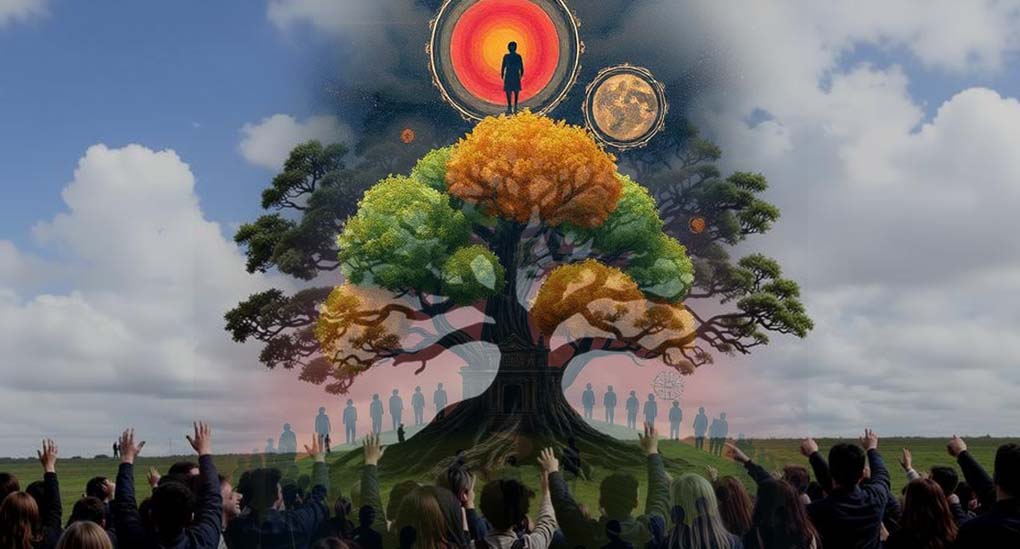
The teachings of the Bahá’í Faith assert that patriarchy fosters a regressive mindset. By sustaining structural inequality between women and men, it paralyzes collective human progress. Bahá’ís view humanity as a bird possessed of two wings: the male and the female. So long as these two wings are unequal in strength, the bird cannot fly. Until womankind enjoys an equivalent arena of activity and development, humanity cannot wing its way to the heights of real attainment.
While the United Nations has made significant strides over the past several decades, women and girls still bear the brunt of systemic discrimination and senseless violence. Current data on UN Sustainable Development Goal 5 (Gender Equality) reveals a bittersweet reality: progress is visible, but massive roadblocks remain. As for progress achieved the following may be cited: (i) Legislative reforms removing discriminatory laws. (ii) Increased female representation in governance. (iii) Declines in child marriage and female genital mutilation. Persistent barriers that need to addressed urgently include: (i) Women hold only 30% of managerial positions globally, Bahá’ís advocate 50%. (ii) Pervasive sexual violence and ongoing dowry deaths, India has a dismal record. (iii) Uneven distribution of resources and opportunities, despite many laudable Government schemes.
As already noted, governments and civil society organizations worldwide are striving to meet the Agenda 2030 goals, however, the root causes of discrimination persist and systemic barriers must be dismantled to achieve true gender justice. In India, the Right to Equality is enshrined as a Fundamental Right under Articles 14 and 15 of the Constitution—a vital legal bedrock designed to elevate and protect the status of women. Yet, legal text alone cannot alter lived realities without a shift in cultural consciousness.
The High Cost of Exclusion
Extensive empirical research supports the Bahá’í premise: societies that deprive women and girls of their rights invariably lag behind those that champion educational equity and financial independence. When nations oppress or exclude women from the mainstream, they self-inflict a massive brain drain, starving themselves of diverse ideas and untapped potential. In the scientific community, this exclusion narrows the scope of research itself, leaving critical issues unaddressed because the perspectives asking the questions are limited.
Furthermore, because patriarchal societies operate strictly through rigid power dynamics, they default to aggression rather than a paternal, nurturing care. This is devastatingly obvious in conflict zones and failed states. Here, the “patriarchal pleasures” of violence and dominance fracture a society’s capacity for compassion. Cycles of trauma produce generations of individuals conditioned to display a toxic, hyper-masculine image in combat, repeating the very inhumanity inflicted upon them.
Unshackling Both Genders
A pivotal dimension of the Bahá’í teachings is the recognition that patriarchy severely restricts men as well:
“As long as women are prevented from attaining their highest possibilities, so long will men be unable to achieve the greatness which might be theirs.”
In India, religion—or dharma—has historically been weaponized to reinforce patriarchy in three intersecting ways: (i) Using religious ideology to legitimize male authority. (ii) Employing faith-based personal laws to restrict women’s rights regarding inheritance and autonomy. (iii) Allowing patriarchal norms to subtly govern across all major religious traditions.
In sharp contrast, the Bahá’í Writings declare: “Women and men have always been and shall be equal in the sight of God.” The denial of this equality breeds harmful attitudes in men that bleed from the family unit into the workplace, into political arenas, and ultimately onto the stage of international relations. Only when women are welcomed into full partnership will the moral and psychological climate change sufficiently for international peace to emerge.
A New Framework for Justice
To remedy the inequities found in varied religious Personal Laws, the Government of India has signalled a move toward a Uniform Civil Code (UCC). Designed to establish an equal status for women regarding marriage, divorce, maintenance, adoption, guardianship, and succession, the UCC aims to apply uniformly to all citizens irrespective of caste, creed, race, or religion. Several state governments have already formulated and approved their respective UCC bills.
Notably, the administrative framework of the Bahá’í Faith inherently bypasses the patriarchal traps of historical religious systems. Its founder, Bahá’u’lláh, ordained the establishment of the Universal House of Justice—an elected governing council mandated, besides other far-reaching matters, to uphold gender equality as an indispensable requirement for global advancement and lasting peace.
The elimination of prejudice requires a global system of justice built upon equity and fairness for the entire human family. While historical religious traditions acknowledge justice as a divine ideal, they frequently failed to overcome the patriarchal mindsets of their eras. For Bahá’ís, justice finds its ultimate fulfillment in unconditional love. It clears the path for unity, secures human well-being, and possesses the raw power to transform society. As Bahá’u’lláh states: “Justice is a powerful force. It is… the standard-bearer of love and bounty.” Its ultimate objective is clear: “The purpose of justice is the appearance of unity.”
———————————–
*The writer is a social worker, an independent researcher, & member of the Bahá’i Community of India. Views expressed are personal.