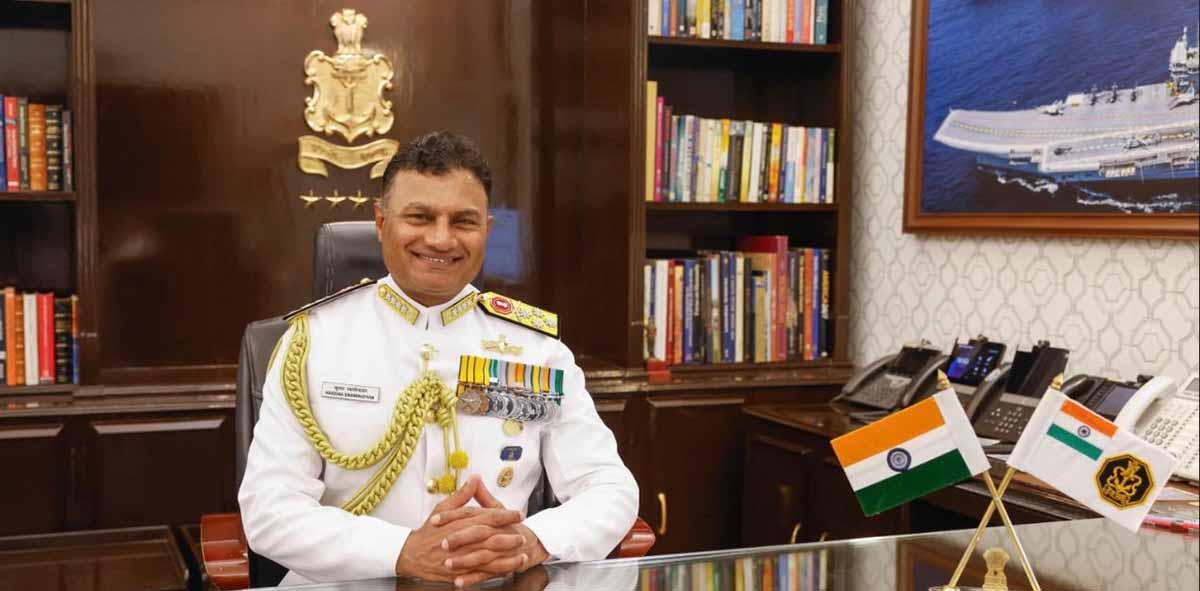
Admiral Krishna Swaminathan’s visit to Port Louis is a goodwill call in name. In substance, it is a stocktaking of one of the Indian Ocean’s oldest and most durable maritime partnerships — and a signal of where it goes next.
The Chief of the Naval Staff, Admiral Krishna Swaminathan, in Port Louis, is here to take forward a relationship that predates the modern Indian Navy’s own blue-water ambitions. India and Mauritius established diplomatic relations in 1948, a year after Indian independence and two decades before Mauritius gained its own. Nearly seventy per cent of the island’s 1.3 million people trace their ancestry to the Indian subcontinent — some 894,500 citizens whose forebears crossed the same waters the two navies now patrol together.
That history is not merely sentimental. In 1901, on his passage from South Africa to India, Mohandas Karamchand Gandhi broke journey in Mauritius and left the island three counsels: pursue education, seek political empowerment, and stay connected with India. Mauritius honours that visit in the most direct way a nation can — its National Day falls on 12 March, the date of the Dandi Salt March.
Geography of Consequence
Mauritius has a coastline of 322 kilometres. It also has an Exclusive Economic Zone of roughly 2.3 million square kilometres — the twentieth largest in the world. That ratio, a small landmass presiding over an ocean expanse the size of a continent, is the single most important fact about Mauritian maritime security, and it explains why India’s naval engagement there has been sustained across seven decades and every government in New Delhi.
It was from Port Louis in 2015 that Prime Minister Narendra Modi first articulated SAGAR — Security and Growth for All in the Region. It was from Port Louis again, in March 2025, that he expanded that framework into MAHASAGAR: Mutual and Holistic Advancement for Security and Growth Across Regions. In September 2025, during Prime Minister Dr Navinchandra Ramgoolam’s state visit to India, the two countries elevated their relationship to an Enhanced Strategic Partnership, accompanied by a development package worth USD 655 million. Bilateral trade now stands at approximately USD 851 million.
The Navy Chief’s visit sits squarely within that arc — the maritime instrument of a partnership that political leadership has already defined.
Ships That Fly Two Flags
India’s contribution to Mauritius’s maritime capability is not an abstraction; it floats. The first vessel, Guardian, was handed over in 1993 for EEZ surveillance. The inshore survey vessel Pathfinder followed in 2013. But the centrepiece is MCGS Barracuda, delivered in March 2015 — the first warship ever built to order in India for a foreign nation, constructed at Garden Reach Shipbuilders and Engineers, Kolkata, at a cost of USD 58.5 million, of which USD 10 million was an outright Indian grant.
Barracuda was followed by MCGS Victory in December 2016 and MCGS Valiant in August 2017, both from Goa Shipyard Limited, and by ten fast interceptor boats between 2016 and 2018. In the air, four Dornier maritime patrol aircraft, four Chetak helicopters and three Advanced Light Helicopters have equipped Mauritius with a maritime air arm capable of search-and-rescue and disaster response across its vast EEZ.
Indian yards have also kept these ships at sea. Refits and life-extension work for the Mauritian fleet have been carried out at Naval Dockyards in Mumbai and Visakhapatnam and at Indian private yards — a quieter form of partnership than a commissioning ceremony, but the one that determines whether a navy actually sails.
The Deeper Investment: People
Hardware ages. Training compounds. Over 1,000 personnel of the Mauritius National Coast Guard have been trained by the Indian Navy to date, and demand is rising sharply — vacancy requests have grown from 50 in 2021-22 to 195 in the current training year.
Some of these milestones deserve wider notice than they have received. In 2025-26, the Naval Special Warfare Tactical Training Centre at Goa opened its doors to a foreign partner nation for the first time in its history, running customised sniper, close-quarter battle and visit-board-search-and-seizure courses for Mauritian personnel. An annual commando and diving refresher course for the Mauritius Commando Force has run without a break since 2008; the sixteenth edition was conducted in Mauritius in November 2025.
And in October 2025, Cadet Juggamah Prisita completed her comprehensive training course at the Indian Naval Academy, Ezhimala — the first woman officer from the Mauritius National Coast Guard to be trained abroad anywhere. It is a small number with a long shadow.
Charting the Ocean, Together
Perhaps the least glamorous and most consequential strand of the relationship is hydrography. Under a memorandum of understanding first signed in 2005 and renewed in October 2025 for a further five years, Indian survey ships have deployed to Mauritian waters on eighteen occasions and completed forty-seven surveys. Mauritius was accorded Producer Nation Status in March 2013, and the two countries have since jointly produced thirteen paper charts and fifteen electronic navigational charts.
Those charts now sell commercially. In April 2026, on the sidelines of the ninth Indian Ocean Conference in Port Louis, External Affairs Minister Dr S Jaishankar handed over a royalty cheque of USD 45,000 to the Government of Mauritius from their sale — a partnership that began as assistance and has matured into revenue. A further joint survey is scheduled for late 2026, during which India will gift Mauritius a new survey motor boat.
From Bilateral to Regional
Mauritius today is not merely a recipient of Indian naval engagement but a participant in the architecture India is helping build. It was among nine African and Indian Ocean nations at the inaugural edition of Exercise AIKEYME — Africa India Key Maritime Engagement — co-hosted with Tanzania in April 2025. Mauritian personnel have sailed on both editions of IOS SAGAR, the Indian Navy’s flagship regional deployment. Mauritius is a member of the Indian Ocean Naval Symposium, an active participant in the Colombo Security Conclave, and hosts India’s longest-serving International Liaison Officer at the Information Fusion Centre – Indian Ocean Region, Assistant Superintendent of Police Geeandeo Cheetamun, in post since January 2022.
A technical agreement on White Shipping Information Exchange, signed during the Prime Minister’s March 2025 visit, now allows the two navies to share merchant traffic data. With Indian assistance, Mauritius is establishing a National Maritime Information Sharing Centre in Ebene, intended to become the island’s own hub for maritime domain awareness and its node in the wider regional network.
What the Visit Means
Goodwill visits are easy to under-read. But slots on a Navy Chief’s calendar are the scarcest resource in a service of that size, and where it is spent is itself a statement of priority.
Admiral Swaminathan travels to a country that has trained a thousand of its coast guardsmen in India, sails ships built in Indian yards, navigates by charts drawn jointly with Indian surveyors, and shares a maritime picture with Indian operations rooms. During the visit, the Chief of the Naval Staff is scheduled to call on the Prime Minister of Mauritius and other senior government officers. The visit affirms something that has been true for fifty years and is worth restating in an ocean where the terms of security are being contested: India’s engagement with Mauritius is not transactional, not recent, and not conditional, but a strong cultural, economic and security bonding between two maritime neighbours to promote regional stability.