A nation of 1.3 million people presides over 2.3 million square kilometers of sea, sits astride the sea routes that matter
Sometimes it helps to look at the Indian Ocean not as it appears from Delhi, but as it appears from the bridge wing of a merchant ship. The great trunk routes of this ocean run from the Malacca Strait to Hormuz and Bab-el-Mandeb, and from the Cape of Good Hope up the East African littoral. The second of these sea routes was, for over a generation now, the quieter one. It is quiet no longer. As attacks on shipping make the Red Sea a calculated risk, tonnage that once transited Suez is increasingly turning to the longer way around. South-western Indian Ocean — the Mozambique Channel, the Mascarene Plateau, the waters south of Madagascar — has re-acquired a strategic weight it has not carried since the age of sail.
Mauritius sits at the hinge of that geography. Its land area is barely 2,000 square kilometres. Its Exclusive Economic Zone runs to roughly 2.3 million — more than a thousand times its landmass — and beyond that lies a further 396,000 square kilometres of extended continental shelf in the Mascarene Plateau region, seabed over which Mauritius and Seychelles exercise joint jurisdiction. Mauritius holds sovereign rights over an expanse of ocean the size of a subcontinent, and possesses, on its own, insufficient means of policing it. That gap between entitlement and capability is not a 11 Mauritian capability void; it is a geopolitical vacancy.
India has recognised this and a relationship that could easily have been reduced to diaspora sentiment has instead been built around coast guard ships, maritime patrol aircraft, hydrographic surveys and information-sharing.
Kinship as Strategy
Roughly seven in ten Mauritians trace their ancestry to the Indian subcontinent. Diplomatic relations were established in 1948, two decades before Mauritian independence. The island’s National Day falls on 12 March, the date Mahatma Gandhi began the Salt March. But affinity is a starting condition, not a policy, and its strategic value lies in something more prosaic: it buys India durability and access that no other external power enjoys, across changes of government in both capitals.
What India has done with that access is substantial. It was from Port Louis in 2015 that Prime Minister Narendra Modi first set out SAGAR — Security and Growth for All in the Region — and from Port Louis again in March 2025 that he expanded it into MAHASAGAR. The two countries concluded a Comprehensive Economic Cooperation and Partnership Agreement in 2021, India’s first trade agreement with an African state. Mauritius has for decades been among the largest conduits of foreign direct investment into India. In September 2025 the relationship was elevated to an Enhanced Strategic Partnership, accompanied by a development and economic package running to several hundred million dollars.
The Chinese Angle
There is no PLA facility at Port Louis. Mauritian politics, its Indian-origin electorate and its careful non-alignment make that implausible for the foreseeable future. So, the Chinese play is subtler and, in some ways, harder to pin down. In January 2021 the China–Mauritius Free Trade Agreement came into force, Beijing’s first with any African country. It gave Mauritian exporters duty-free access on thousands of tariff lines and gave Chinese firms a compliant, English-speaking, common-law jurisdiction from which to headquarter African operations under the continental free trade area. Bilateral China–Mauritius trade has since run ahead of India–Mauritius trade. Beijing has financed the Bagatelle dam, an airport terminal, the Jinfei economic and trade zone, and has signed arrangements touching port infrastructure and fisheries. Chinese research and survey vessels have become a regular feature of the south-western Indian Ocean, and PLA Navy escort task forces have made port calls in the region as a matter of routine.
The risk for India is no Chinese garrisoning as yet. It is leverage: over an EEZ where survey and fishing rights are worth a great deal, over the terms on which infrastructure gets built, over votes in multilateral forums, and over the fiscal room of a small state with large obligations. Influence accumulated this way is rarely announced. It is discovered later, at the moment it is used.
Chagos: the Unfinished Business
And then there is Chagos, which has moved in eighteen months from a diplomatic triumph to being a delicate and unresolved matter once again. The archipelago was detached from Mauritius in 1965, three years before independence, for three million pounds; its inhabitants were removed to make way for the joint Anglo-American base in Diego Garcia. In 2019 the International Court of Justice found the continued British administration unlawful and the United Nations General Assembly endorsed that view. After a decade of pressure and two years of negotiation, the United Kingdom and Mauritius signed a treaty on 22 May 2025 recognising Mauritian sovereignty over the entire archipelago while leasing Diego Garcia back to Britain for ninety-nine years at some £101 million a year. India welcomed it as the completion of Mauritius’s decolonisation.
The agreement has not entered into force. In January 2026 President Trump reversed Washington’s earlier support, calling the deal an act of “total weakness”; a month later he publicly instructed London not to give Diego Garcia away, invoking the base’s role in operations against Iran. Britain paused ratification of the treaty. Britain acquired a new Prime Minister on 20 July. Officials indicate policy will not change. Meanwhile Diego Garcia has become hotter, not cooler. American strikes on Iran have reportedly been flown from the atoll, and Iranian missiles were claimed to have been fired at it, in March earlier this year. Port Louis remains a bystander to this play.
Why this matters in New Delhi
India’s stake in the Chagos question runs along three lines.
The first is principle. Support for Mauritian sovereignty has been consistent across governments – the language has been of decolonisation, sovereign equality and international law. It is the language that India uses in the Global South.
The second is position. If the transfer completes, the most important military facility in the Indian Ocean will sit on the sovereign territory of India’s closest partner in the region rather than on a British overseas territory in which India has no standing whatever. India has already agreed to assist Mauritius with the development and surveillance of the Chagos Marine Protected Area, and Port Louis has asked for an Indian Naval vessel to carry its flag to the archipelago — which would make the Indian Navy, the instrument through which Mauritian sovereignty is first exercised.
The third is risk. A Mauritius that has been financially stressed and diplomatically pushed is a Mauritius with more reason to listen to other courting patrons, and Beijing has been building the relationship for exactly such a moment.
The Navy Chief’s visit
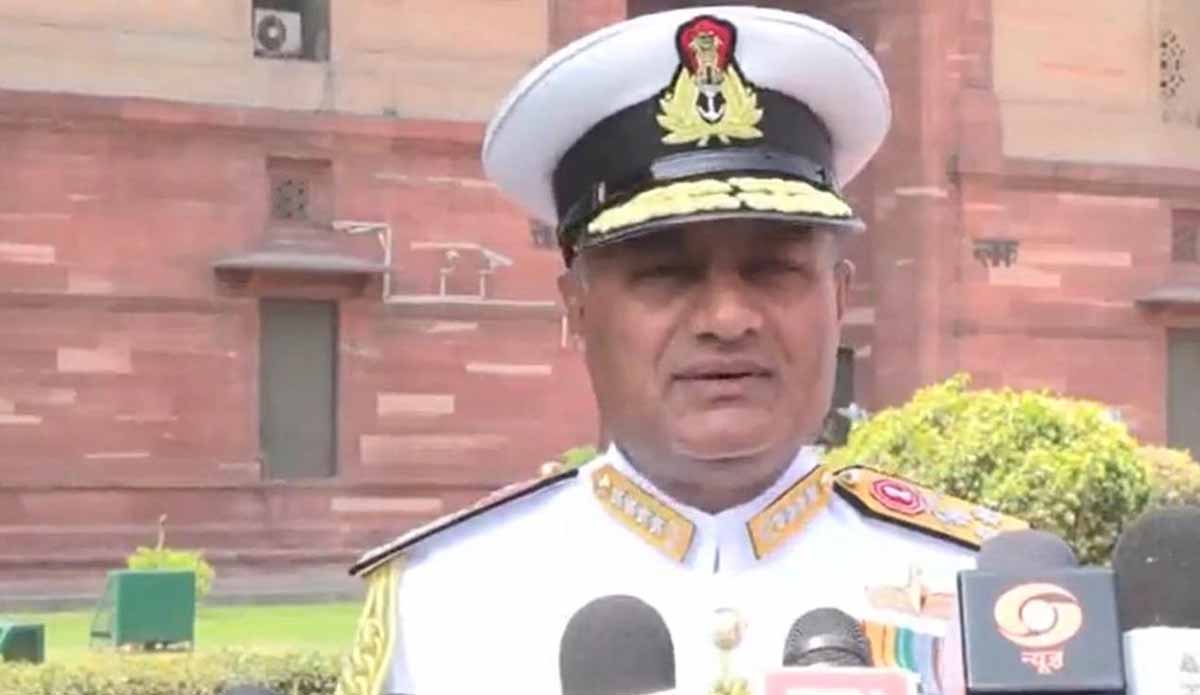
With this backdrop, the Chief of the Naval Staff’s visit to Port Louis from 10 – 14 Aug, is of immense significance to further cement our relationships. Admiral Krishna Swaminathan travels to a country whose coast guardsmen have been trained in Indian establishments, which sails ships built in Indian yards and navigates by charts drawn jointly with Indian surveyors. He arrives at a moment when the terms of Mauritian sovereignty are being settled in London and Washington rather than in Port Louis, and when the practical content of that sovereignty — whenever it comes — will rest on capability Mauritius does not yet hold. The visit is part of the maritime instrument of a partnership that political leadership has already defined; its work is to convert declarations into tangible outcomes.