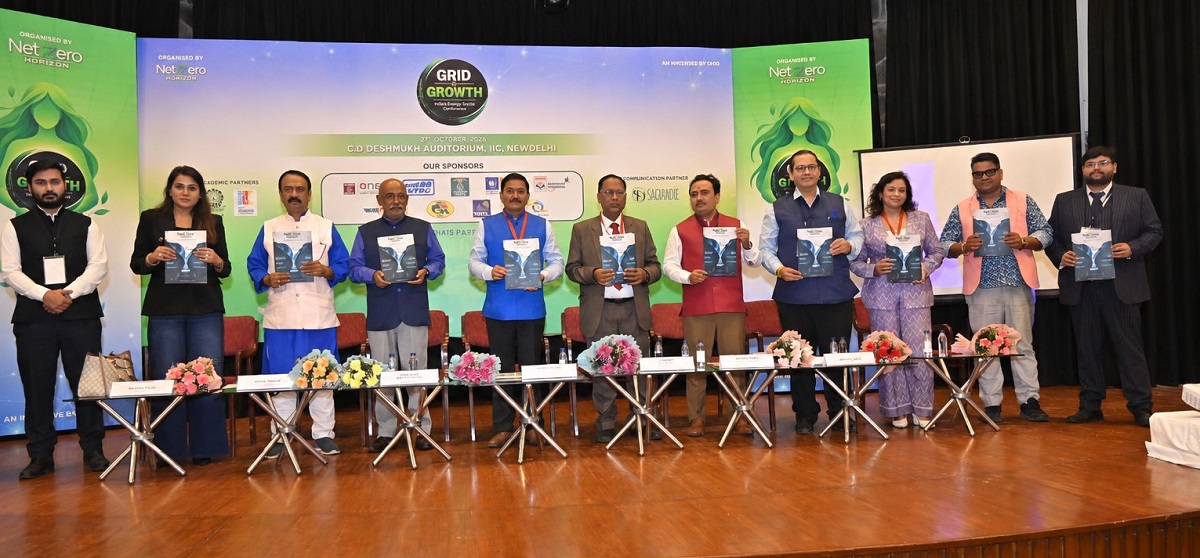
New Delhi, 12 November 2026: NetZero Horizon (NZH) hosted Grid to Growth 2026, India’s Energy Sector Conference, on Tuesday, 27 October 2026 at the India International Centre, New Delhi. Organised in academic collaboration with BITS BioCyTiH Foundation and NIT Durgapur, the conference brought together senior voices from government, public sector undertakings, regulation, research and industry to discuss how India’s power grid must evolve to support the Viksit Bharat 2047 vision and the country’s Net Zero 2070 commitment.
The conference started from a practical problem. India is adding renewable capacity at speed, but clean power counts for little if the grid cannot carry it reliably from where it is generated to where it is used. Transmission bottlenecks, limited storage and grid stability set the agenda for the day, alongside newer risks from artificial intelligence and cyber attacks on grid systems.
“Adding renewable capacity is only half the task. The grid has to carry that power securely, and the people who research, build and regulate it have to work from the same table,” said Shri Rahul Deo, Editor-in-Chief, NetZero Horizon. “Grid to Growth was set up as that table. The Defence Secretary’s message makes clear that grid resilience is now a matter of national security as well as energy policy. NetZero Horizon will keep taking these conversations to the rooms where decisions are made.”
Defence Secretary’s message on energy security
A message from Shri Rajesh Kumar Singh, Defence Secretary, Government of India, was read out at the conference by Shri Rahul Deo, Editor-in-Chief, NetZero Horizon.
“Today, grid security is no longer just about maintaining physical infrastructure; it is about absolute operational resilience in the face of rapid renewable energy integration,” the Defence Secretary said. With India targeting 500 GW of non-fossil capacity by 2030, he noted that the Government is enforcing stricter balancing discipline, deploying AI-driven demand forecasting and scaling up battery and pumped storage.
“True national sovereignty relies on total self-reliance, an Atmanirbhar Bharat in power,” he said, pointing to the mandate for an indigenous architecture by 2029 and PLI support for domestic component manufacturing.
“Energy security along our border areas is a matter of critical national security and territorial integrity,” he said, outlining a vision to deploy 10,000 grid-interactive microgrids across the country, particularly in difficult terrain and border districts, and to reduce the defence forces’ reliance on vulnerable diesel supply lines.
“Through this unified approach—combining rigid security, strict localization, fortified border energy infrastructure, and decentralized innovation—we are building a power sector that is not only green, but completely bulletproof, sovereign, and self-sustaining,” the message concluded.
Special and expert addresses
Shri Deepak Thakur, Hon’ble Member, Ministry of Culture, and President, NetZero Horizon, delivered the Special Address. Expert addresses followed from Dr Arvind Nema, Deputy Director (Operations), IIT Delhi; Dr Anil Wali, CEO, BITS BioCyTiH Foundation; Shri Raj Kumar Choudhary, Former CMD, NHPC, and Chairperson, Joint Electricity Regulatory Commission for the UT of Jammu & Kashmir and the UT of Ladakh (JERC); and Prof. Arvind Chaubey, Director, NIT Durgapur. Between them, the speakers brought experience from institutional research, technical education, hydropower and electricity regulation to the conference’s questions on grid modernisation.
Panel: Mobilising Society for Net Zero Goals 2070
The panel session, “Mobilising Society for Net Zero Goals 2070”, was moderated by Dr Shibshankar Bhattacharya, Former Technical Consultant, BITS BioCyTiH Foundation. The panellists were: ▪ Ms Ekatmika Khatua, CEO, Temporal Dynamics
▪ Group Captain Dr S.N. Mishra, Visiting Professor, TERI School of Advanced Studies, and Former Director, Indian Air Force, Government of India
▪ Dr Subash N. Pillai, Head, Division of Agricultural Physics, and Principal Scientist, ICAR-IARI ▪ Prof. Chiranjib Koley, Dean (Academic), NIT Durgapur
▪ Dr Jyoti Kumar, Former Chief General Manager and Head, Corporate Communications, GAIL ▪ Ms Sushma Rawat, Former Director (Exploration), ONGC
With backgrounds spanning energy enterprise, defence and policy research, agricultural science, technical education, corporate communications and oil and gas exploration, the panel looked at the transition beyond infrastructure, towards the part communities, institutions and individuals play in reaching the 2070 goal.
NetZero District Model
NZH also presented its flagship NetZero District Model, ideated and designed by NetZero Horizon to develop a district holistically through four pillars: power security, water security, green skilling and community governance. The NetZero District Model – Dimapur (Nagaland) has the support of the Governor of Nagaland, Shri Nand Kishore Yadav; the Deputy Chief Minister of Nagaland, Shri T.R. Zeliang; and Rajya Sabha MP Smt. S. Phangnon Konyak.
Special edition launch
The conference also saw the launch of the special edition of NetZero Horizon magazine, titled “NetZero In a World on Edge”. The magazine follows the same idea as the conference: a common platform where industry, academia, corporates, PSUs and the bureaucracy speak to one another, so that ideas from the field reach the highest levels of decision-making.
About NetZero Horizon
NetZero Horizon (NZH) is an energy-focused publication and events platform working at the intersection of climate, energy and economic policy. An initiative of ISON (Integrated Sustainable Outreach Nyas), NZH publishes NetZero Horizon magazine, convenes policy dialogues such as Grid to Growth, runs a capacity-building programme for net-zero professionals and designed the NetZero District Model.
Media contact: NetZero Horizon | netzerohorizon@gmail.com | www.netzerohorizon.com