
 Najmuddin A. Farooqi.
A critical assessment of ideology, manfesto, commitments, Governance and Political rhetoric during Modi Government’ twelve years (2014-2026): myths, reality or both ?
The BJP’s ideological and cultural commitments must be distinguished from its governance record and constitutional responsibilities. Its election manifestos of 2014, 2019 and 2024 reveal both a sustained cultural-nationalist agenda and a programme of welfare and economic development. Understanding their implementation and consequences for Indian Muslims is essential to an objective assessment.
Political rhetoric, communal polarisation, selective media coverage and certain administrative actions have contributed to apprehension among sections of the Muslim community. The challenge is to distinguish genuine concerns from exaggerated or manufactured anxieties while remaining confident in constitutional rights and participating fully in nation-building.
The Question: Myth, Reality or Both?
Let us examine the BJP’s ideology, manifestos, policies, political rhetoric and administrative actions that have either directly or indirectly been perceived as antagonistic towards Islam and Indian Muslims.
This assessment primarily covers the twelve years of the Modi Government, beginning in 2014, while also considering the wider political environment and the conduct of India’s political establishment in relation to communalism, secularism and what is frequently described as pseudo-secularism.
The objective is not to reach a predetermined political conclusion. It is to distinguish facts from perceptions, promises from implementation and legitimate policy decisions from actions that may undermine constitutional equality and communal harmony.
An honest assessment requires political neutrality and intellectual integrity. The BJP’s emphasis on Hindu civilisational identity is evident in its political programme. However, it would be misleading to claim that the government has achieved nothing worthwhile or that every policy is necessarily directed against Muslims. Conversely, the slogan of Sabka Saath, Sabka Vikas, Sabka Vishwas cannot, by itself, establish that every government action is inclusive. The evidence must speak for itself.
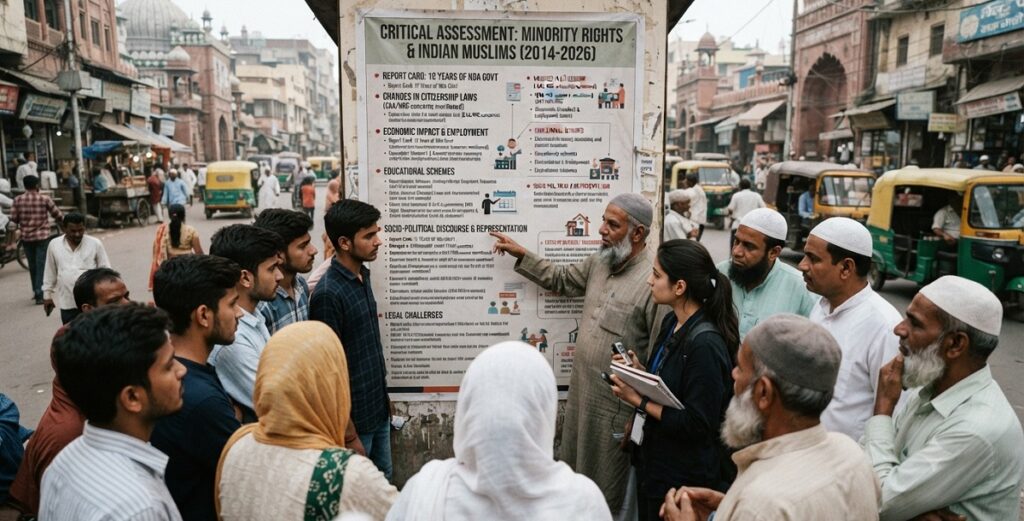
Understanding the Two Dimensions of the BJP’s Political Agenda
The BJP’s programme can broadly be examined through two parallel dimensions:
A. Cultural and Hindutva-oriented agenda – Virasat
This includes Ram Mandir, Article 370, Uniform Civil Code, citizenship legislation, cultural heritage and other commitments associated with the party’s ideological identity.
B. Inclusive development agenda – Vikas
This encompasses poverty alleviation, agriculture, women’s empowerment, healthcare, employment, infrastructure, economic development and welfare programmes intended for the wider population.
Both dimensions deserve recognition. The existence of one does not automatically negate the other. Their political implications, particularly for religious minorities, must nevertheless be examined independently.
The following tables compare the BJP’s manifestos of 2014, 2019 and 2024.
Section A: Cultural / Hindutva Agenda – ‘Virasat’
| Issue | 2014 Manifesto | 2019 Manifesto | 2024 Manifesto |
|---|---|---|---|
| 1. Ram Mandir, Ayodhya | Construction within the constitutional framework | Reaffirmed commitment within the constitutional framework | Consecration on 22 January 2024; global Ramayana Utsav |
| 2. Article 370 – J&K | Build consensus for abrogation | Explicit commitment to abrogate Articles 370 and 35A | Abrogation implemented on 5 August 2019; emphasis on peace and development |
| 3. Uniform Civil Code | Common Civil Code linked to gender equality | Reaffirmed as necessary for gender equality | Reaffirmed; cited Uttarakhand’s UCC as an example |
| 4. Return of Kashmiri Pandits | Ensure safe return | Safe and dignified return | No separate commitment under this heading |
| 5. Citizenship – CAA | Protection and shelter for Hindus; address illegal immigration | CAA legislation and nationwide NRC in phases | CAA Rules notified in 2024; NRC omitted |
| 6. Triple Talaq | No specific commitment | Commitment to abolish these practices | Law against instant triple talaq enacted in 2019; no separate 2024 commitment |
| 7. Ganga / Cultural Heritage | Clean Ganga and preserve cultural heritage | Kashi Vishwanath Corridor and Namami Gange | ‘Virasat bhi, Vikas bhi’; development of Kashi, Mathura and Ayodhya |
| 8. One Nation, One Election | Not specifically mentioned | Build consensus for simultaneous elections | Explicit commitment to implement |
The emerging pattern
- 2014: Ideological commitments were presented primarily as promises to be pursued within the constitutional framework.
- 2019: Several commitments became more explicit and were translated into legislative or executive action, including Article 370, CAA and the law against instant triple talaq.
- 2024: Major commitments such as the Ram Mandir and Article 370 were presented as fulfilled, while the UCC and One Nation, One Election were reiterated.
The table demonstrates continuity in the BJP’s cultural-nationalist agenda. It does not, by itself, establish that every commitment was anti-Muslim or that its implementation necessarily violated constitutional principles.
Section B: Inclusive / Sabka Saath Agenda – ‘Vikas’
| Issue | 2014 Manifesto | 2019 Manifesto | 2024 Manifesto |
|---|---|---|---|
| 1. Poverty alleviation | Sabka Saath, Sabka Vikas; toilets and bank accounts | Expansion of PM Awas, Ujjwala and Ayushman Bharat | Free ration for five more years, three crore additional houses and PM Surya Ghar |
| 2. Farmers | MSP and Kisan Credit Card | PM-KISAN: ₹6,000 annually; agricultural credit commitments | Continuation of PM-KISAN, crop insurance and promotion of natural farming |
| 3. Women | 33% reservation commitment; Beti Bachao, Beti Padhao | Reaffirmed reservation and legislation against instant triple talaq | 33% reservation legislation enacted in 2023; three crore Lakhpati Didis |
| 4. Youth / Employment | Skill India, Startup India and Digital India | Startup promotion, Mudra loans and employment commitments | Mudra limit raised to ₹20 lakh; one crore internship opportunities and action against examination paper leaks |
| 5. Healthcare | National Health Assurance | Ayushman Bharat, coverage up to ₹5 lakh | Extension of Ayushman Bharat to all senior citizens aged 70+ and transgender persons |
The emerging pattern
- 2014: Welfare and development were presented as national priorities alongside ideological commitments.
- 2019: The emphasis was on implementing major welfare programmes while advancing longstanding ideological commitments.
- 2024: The focus included Viksit Bharat 2047, welfare delivery, infrastructure and the empowerment of four groups: Garib, Yuva, Annadata and Nari Shakti (GYAN).
Where Does the Concern of Indian Muslims Arise?
Every political party is entitled to pursue its ideology and electoral mandate, provided its policies and actions remain within the Constitution. The real concern arises when political mobilisation or administrative conduct creates an environment in which a religious community feels insecure, excluded or treated as a suspect population.
Mob lynching and vigilantism: Incidents of mob violence, particularly involving allegations of cow slaughter, cattle transportation or possession of beef, have generated considerable apprehension among Muslims. No individual or group has the authority to assume the functions of the police or judiciary. The government must prevent vigilantism, investigate impartially and prosecute perpetrators.
Criminal allegations, arrests and detention: Complaints concerning selective arrests, prolonged detention, serious criminal provisions and inadequate protection against arbitrary action require examination through court records and investigation outcomes. Presumption of innocence, access to legal representation and protection against arbitrary detention are constitutional safeguards, not religious privileges.
Demolition of properties: Demolitions of houses, commercial establishments, mosques and other properties, particularly where communal selectivity is alleged, have become another source of concern. Illegal construction may warrant administrative action, but punitive demolition without due process cannot be justified merely by an allegation of criminal wrongdoing.
Mosques, madrasas and religious institutions: Regulation of educational standards, religious institutions and public land is a legitimate administrative responsibility. However, selective interference or disproportionate enforcement that appears to target institutions because of their religious character can undermine confidence in the state’s neutrality.
Minority educational scholarships: The discontinuation or non-renewal of several Central Government minority scholarship schemes has caused concern among economically disadvantaged students. The reasons, subsequent academic impact and availability of equivalent alternatives deserve transparent examination. Students should not lose educational opportunities through the withdrawal of targeted assistance without adequate alternatives.
Compensation and relief: Allegations of discriminatory treatment following communal riots, accidents, natural disasters or other catastrophes must be investigated. Relief and compensation should depend on established eligibility criteria, actual losses and applicable law—not religious identity.
These are substantive governance concerns, but allegations must be assessed on evidence and individual cases rather than treated as universally established facts.
Political Rhetoric: The Other Side of the Problem
Not every concern affecting Muslims originates in a government order or administrative action. Political rhetoric can be equally consequential. Repeated statements portraying Muslims collectively as infiltrators, demographic threats, appeasers or security risks can create an atmosphere of suspicion.
At the same time, statements by individual leaders should not automatically be attributed to every party member or treated as official government policy. A distinction must be maintained between individual rhetoric, an established party position and an actual government decision.
The BJP frequently presents itself as committed to genuine secularism, sometimes arguing that Hindu civilisational traditions are inherently inclusive. But claiming that Hindus are naturally secular does not establish that every political position advanced in the name of Hinduism is necessarily secular.
Likewise, branding political opponents or citizens who disagree with the BJP as pseudo-secular or pro-Muslim is little more than a self-proclamation of being the champions of Hinduism.
Indian Muslims, too, must not be collectively characterised as communal, anti-national or disloyal because of the actions or statements of particular individuals. A citizen’s constitutional identity cannot be determined by religious affiliation.
CAA, NRC and the Question of Citizenship
The Citizenship Amendment Act (CAA) and the proposed nationwide National Register of Citizens (NRC) require separate examination.
The CAA provides an expedited citizenship route for specified religious communities from Afghanistan, Bangladesh and Pakistan who entered India on or before 31 December 2014, subject to statutory conditions. Its exclusion of Muslims from these specified neighbouring countries has generated constitutional and political debate concerning equality and religious discrimination.
The nationwide NRC was explicitly mentioned in the 2019 manifesto but omitted from the 2024 manifesto. That omission should not be interpreted as a formal legal withdrawal. Indian citizens should remain informed about these issues without succumbing to exaggerated fears or unsupported political narratives.
Media and the Manufacture of Perception
An unfortunate casualty of India’s polarised political environment has been objective journalism. Sections of electronic and social media appear more interested in sensationalism, ideological positioning and communal narratives than balanced reporting.
Some platforms amplify Islamophobic narratives and portray Muslims through a negative collective image. Others adopt an equally uncritical approach towards political parties and governments, overlooking legitimate questions of accountability. Both tendencies damage public understanding.
Responsible media must investigate mob violence, discriminatory conduct and administrative excesses wherever they occur, while also acknowledging legitimate achievements in governance. Neither uncritical government publicity nor indiscriminate opposition propaganda serves democracy.
The Larger Political System: Communalism, Secularism and Pseudo-Secularism
It would be intellectually dishonest to place the entire responsibility for India’s communal tensions on one political party or government. Communal mobilisation has existed across the political landscape for decades. Parties of different ideological orientations have, at various times, used religious identity, caste and community interests for electoral advantage.
The misuse of secularism for political convenience deserves criticism. However, using the label pseudo-secularism to discredit every concern relating to minority rights is equally problematic.
Indian secularism does not require the state to be hostile to religion, nor does it authorise preferential treatment based on political convenience. Its essential constitutional requirements are equal citizenship, freedom of conscience, religious liberty and protection against discrimination.
The government of the day is the custodian of these constitutional guarantees, not the owner of the country or its civilisational identity.
Beyond Political Rhetoric: Towards Constitutional Confidence
There is demonstrable continuity in the BJP’s Hindu cultural-nationalist agenda. There is also a substantial record of welfare programmes, infrastructure development, economic initiatives and social-sector interventions intended for the wider population.
However, development achievements cannot be used to dismiss allegations of discrimination, vigilantism, selective enforcement or institutional failure. Equally, political rhetoric and isolated incidents should not be used to deny every government achievement or portray the entire administration as uniformly hostile to Muslims.
The distinction between myth and reality is therefore not absolute. Some apprehensions may be exaggerated by political propaganda and sensationalist media; others may arise from genuine incidents, policy choices or failures of governance that require accountability.
For Indian Muslims, the appropriate response is neither fear nor confrontation. They must remain confident in their constitutional citizenship, exercise democratic rights, pursue education and economic advancement, participate in public institutions and contribute to national development. They should neither accept an imaginary sense of collective victimhood nor remain silent when genuine violations of constitutional rights occur.
The Constitution belongs equally to every Indian. Its protections are neither favours granted by a political party nor privileges dependent on religious identity. Indian Muslims have no reason to feel politically homeless or constitutionally insecure merely because the political establishment changes. They are equal stakeholders in India’s past, present and future.
The future of the country cannot be secured through religious insecurity, political polarisation or competing claims of ownership over the nation. It must rest on constitutional morality, mutual respect, justice, responsible governance and equal opportunity.
The ultimate test of any government is not how effectively it promotes the identity of the majority, but how confidently every citizen including those belonging to religious minorities can live, prosper and participate in the nation without fear, discrimination or prejudice.
That is the standard by which the BJP, its political opponents and the entire Indian political establishment must be judged.