 Dr. A. K. Merchant.
The season of festivals offers humanity an opportunity not merely to celebrate religious traditions but also to reflect upon their deeper spiritual message: love, compassion, justice, unity and peace. Among the significant occasions celebrated during this festive season soon after Dussehra and Durga Pujo celebrations are the Birthdays of the Twin Founders of the Bahá’í Faith—the Báb (1819–1850) and Bahá’u’lláh (1817–1892). Their advent, separated by two years in history but united by a profound spiritual relationship, heralded a new era in humanity’s religious and social evolution.
In November 2026, Bahá’ís across the world will celebrate these Twin Holy Days on 10 and 11 November, as per the Bahá’í Calendar now in its 183rd year. The celebrations take place amid India’s wider season of religious and cultural festivities, including Deepavali, Chhath and Guru Nanak Jayanti. Such occasions provide a particularly meaningful opportunity to reflect upon the common spiritual heritage that connects humanity across religious and cultural boundaries.
Although the Báb and Bahá’u’lláh were born two years apart, their birthdays are known as the Twin Birthdays because they correspond to consecutive days as per the Bahá’í Calendar that has eleven Holy Days, some of which are observed as per their lunar dates as ordained in His Kitáb-i-Aqdas, (Most Holy Book), regarded as the book of laws and charter of the new World Order. Bahá’u’lláh declared that the Twin Birthdays are accounted as “one” in the sight of God and to be celebrated as continuous two-day festival, following the eighth new moon after Naw-Rúz, coinciding with the Spring Equinox, which is the commencement of the New Year.
A distinctive feature of the Bahá’í calendar is that each day begins at sunset and concludes at the following sunset. Consequently, the celebrations commence at sunset on the evening preceding the first designated date and continue through the second day. Some of the Bahá’í Holy Days are solemn observances however, the Twin Birthdays are an occasion of joy, prayer, reflection and fellowship. Families, friends and communities gather in homes, community centres, houses of worship, and other venues for devotional readings, prayers, music, poetry, storytelling and festive meals. There is no rigid, prescribed ceremonial format; the manner of celebration reflects the cultural richness and diversity of Bahá’í communities around the world.
To appreciate the significance of these celebrations, it is essential to understand the relationship between the two central figures of the Bahá’í Faith. The Báb, whose title means “the Gate”, announced His mission in Shiraz, Persia, in May 1844. As the Prophet-Herald of the Faith, He proclaimed that humanity was approaching a new stage of spiritual development and prepared His followers for the advent Bahá’u’lláh, the divine Messenger prophesied in all the Sacred Scriptures, Who would usher in an age of peace and justice. The Báb’s mission lasted only six years, ending with His martyrdom in 1850.
Bahá’u’lláh, whose name means “the Glory of God” through His extensive writings and teachings, articulated a vision of a new world civilization founded upon the oneness of God, the essential unity of religions and the oneness of humanity. His mission continued until His passing in 1892. “The earth is but one country, and humankind its citizens.” The celebration of their birthdays on consecutive days symbolizes the continuity of divine guidance and the transition from the Forerunner to the Promised One.
Festivals are expressions of the unity of religion aka dharma. They offer an opportunity to contemplate a universal spiritual principle shared, in different forms, by the great religious traditions of the world. Human civilization has been enriched by successive Divine Educators, known in different traditions as Prophets, Messengers, Avatars, Tathāgatas and Tīrthaṅkaras. Each, within a particular historical and cultural context, has contributed to humanity’s moral, spiritual and intellectual advancement. The Bahá’í teachings emphasize the essential unity of the world’s religions, as successive expressions of one divine purpose, suited to the needs and capacities of humanity at different stages of its civilizational evolution. Viewed in this light, religious festivals should be more than occasions for ceremonial observances, elaborate rituals or social entertainment. They should inspire people to rediscover the ethical and spiritual teachings at the heart of their respective Faiths.
The concept of dharma, understood in its deeper ethical and spiritual dimensions, reminds us of our responsibility towards fellow human beings and the larger world. When religion becomes a force for truth, compassion, justice and service, it can serve as one of the greatest instruments for establishing social harmony and peace. Unfortunately, religious identity is sometimes manipulated to advance vested interests, perpetuate prejudice and promote divisions. Superstition, fanaticism, intolerance and blind adherence to customs can overshadow the original spiritual message. Commercialization can also reduce sacred occasions to display wealth, consumption and entertainment, leaving their deeper meaning largely forgotten.
The fundamental teachings of the Faith-based traditions, including the Golden Rule—to treat others as we would wish to be treated ourselves—must therefore be restored to the centre of religious and social life. Political ideologies, narrow nationalism, racial prejudice and sectarian interests should never be allowed to undermine the dignity and unity of humanity.
Humanity at a crossroads presents a striking contradiction. Never before has the planet been so heavily populated; never before humanity possessed such extraordinary scientific knowledge, technological capabilities and means of communication. Yet conflicts, wars, economic inequalities, intolerance and environmental degradation threaten the very survival of civilization, as we know it. At a time when people across nations are earnestly seeking peace and security, the persistence of hatred, aggression and divisions raises fundamental questions about the role of religion aka dharma and the impact of science and technology. As per the Security Board of Bulletin of Atomic Scientists the world is just 85 seconds to midnight on the Doomsday Clock. With less than four years left the Secretary General of the United Nations has repeatedly lamented on the collective failure member states to advance the Sustainable Development Goals.
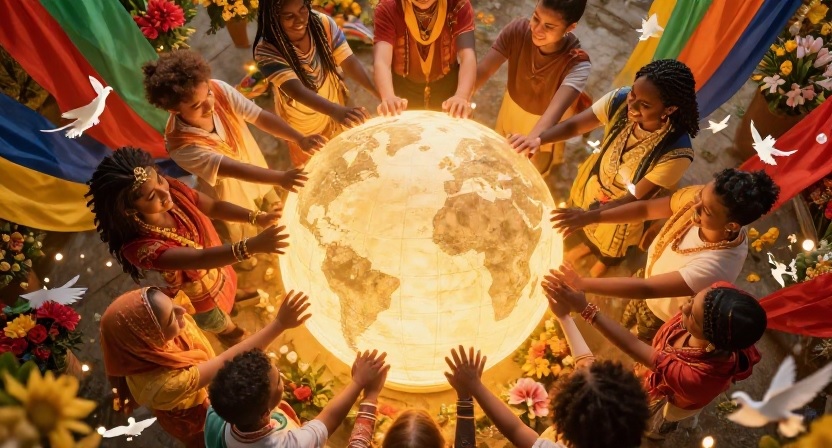
The challenge is not merely to achieve material progress but to ensure that such progress is guided by spiritual values, moral responsibility and collective wisdom. Rapid technological developments, including artificial intelligence, make this responsibility even more urgent. The Bahá’í teachings maintain that the ultimate solution to humanity’s problems lies in recognizing the oneness of the human race. This does not require the erasure of cultural, linguistic or religious diversity. Rather, it calls for a civilization in which such diversity becomes a source of strength, mutual enrichment and collective progress.
As already stated earlier the Bahá’í writings envisage a system of international cooperation and global governance that would protect the rights of nations while safeguarding the common interests of humanity. This vision includes institutions such as a world legislature, an international executive and a supreme tribunal empowered to resolve disputes between nations and prevent wars and conflicts. Such a world order would encourage the removal of economic barriers, equitable utilisation of the planet’s resources, recognition of the interdependence of capital and labour, and the establishment of justice as the guiding principle of international relations. This is not merely an appeal for goodwill. For Bahá’ís, the establishment of the unity of humankind is an essential and ultimately inevitable stage in humanity’s collective development. The responsibility of every generation is to contribute towards its realization.
The celebration of the Twin Birthdays carries a message that is particularly relevant to our times. It invites people of all Faiths and backgrounds to look beyond outward differences and recognize the common spiritual heritage of humanity. The true measure of a festival should not be the grandeur of its celebrations but the degree to which it inspires compassion, generosity, understanding and service to others. Whether it is Deepavali, Eid, Christmas, Easter, Guru Nanak Jayanti, Vesak, Chhath, Naw-Rúz, or the Twin Birthdays of the Bahá’í Faith, each occasion offers an opportunity to strengthen the bonds of mutual respect and human fellowship.
The need of the hour is not uniformity of belief but unity in diversity—a world in which every individual, irrespective of religious affiliation, nationality or social background, is treated with dignity and respect. Bahá’u’lláh expressed this universal vision in unmistakable terms: “The well-being of mankind, its peace and security, are unattainable unless and until its unity is firmly established.” These words remain profoundly relevant in a world confronted by unprecedented challenges. Humanity must learn to see itself not as a collection of competing communities and nations but as one interconnected family sharing a common planetary home. “These fruitless strifes, these ruinous wars shall pass away, and the ‘Most Great Peace’ shall come,” is Bahá’u’lláh’s solemn promise. The Twin Birthdays, therefore, are not simply commemorations of two historic spiritual personalities. They are a reminder of humanity’s unfinished journey towards unity, justice and universal peace—and an invitation to every individual to become a conscious participant in building.