 Najmuddin A. Farooqi (Writer and Independent Observer)
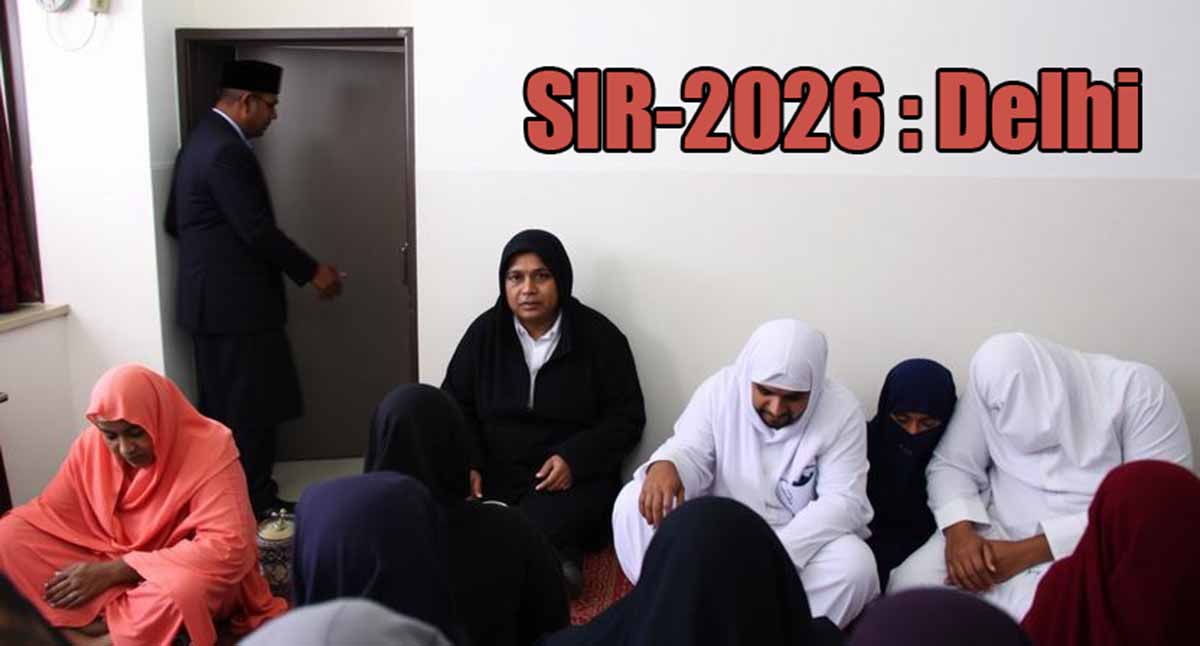
Delhi SIR 2026: 47.56 lakh names missing from draft roll, but final deletions yet to be determined
A neutral analysis of the Special Intensive Revision examines the reasons for exclusions, constituency-wise variations, concerns about Muslim-dominated areas and the role of political parties and voters.
47,56,722 electors did not find place in Delhi’s Draft Electoral Roll published on August 31, 2026, but their exclusion at this stage should not automatically be treated as final deletion.
The largest category, comprising 43,32,775 electors, relates to those classified under Absent/Shifted/Others, while 2,82,412 are categorised as deceased and 1,41,535 as duplicate/multiple enrolments.
Constituency-wise figures show significant variations; while Okhla and Chandni Chowk have relatively high exclusion rates, several other Muslim-dominated constituencies are below the Delhi average.
The exercise raises questions about the role of political parties and their Booth Level Agents (BLAs) in continuously identifying eligible but unregistered voters and discrepancies in electoral rolls.
The final assessment will depend upon the claims-and-objections process and the final electoral roll, since every genuine voter must have an effective opportunity to seek inclusion.
The net average of overall exclusion is 32.80% and that of Muslim dominated localities it is 31.37%.
A Brief Neutral Study — SIR 2026, Delhi
The publication of Delhi’s Draft Electoral Roll on 31 August 2026, following the Special Intensive Revision (SIR), has generated considerable public and political debate. With a large number of names not appearing in the draft roll, questions have naturally arisen about the reasons for these exclusions and whether particular sections of society have been disproportionately affected.
This article is an attempt to examine the available figures objectively and without attributing political motives to either the Election Commission or political parties. The electoral roll is fundamental to representative democracy, and both accuracy of the roll and protection of every eligible citizen’s right to vote are equally important.
A continuation of an earlier study
This is also a continuation of my earlier effort to examine SIR through available electoral data. On 10 April 2026, I published an article titled “Electoral Roll Revision 2026: A Case Study of Lucknow”, examining the SIR exercise in Uttar Pradesh, particularly the changes in Lucknow’s electoral rolls and constituency-wise variations. The present study of Delhi follows the same approach: to place the available facts and figures on record and encourage a discussion based on evidence rather than political perceptions.
The scale of Delhi’s revision
According to figures released in connection with the Delhi SIR, the existing electoral roll contained 1,45,10,299 electors. The Draft Electoral Roll published on August 31 contains 97,53,577 electors. Thus, 47,56,722 names did not find place in the Draft Roll, representing approximately 32.78 per cent of the pre-SIR electorate. However, it is important to make a distinction: these should not yet be described as 47.56 lakh final deletions. They are exclusions from the Draft Roll and remain subject to the prescribed claims-and-objections process.
What are the reasons for exclusion ?
The reported broad break-up is:
Category Electors
Absent / Shifted / Others 43,32,775
Deceased 2,82,412
Duplicate / Multiple enrolment 1,41,535
Total not included in Draft Roll 47,56,722
Included in Draft Roll 97,53,577
The figures show that the overwhelming majority of exclusions are not classified as deceased or duplicate voters. The largest category is Absent/ Shifted/ Others, which therefore deserves particular scrutiny. A high number in this category does not by itself establish wrongful deletion. It may include people who have shifted residence, could not be contacted at the recorded address, or whose enumeration process could not be completed for various reasons.
What about Muslim dominated constituencies
This is perhaps the most politically sensitive aspect of the Delhi exercise. Available constituency-wise figures show substantial variations among constituencies generally regarded as having sizeable Muslim populations:
Okhla — approximately 45.3%
Chandni Chowk — 38.9%
Ballimaran — 32.6%
Mustafabad — 28.0%
Babarpur — 27.0%
Matia Mahal — 24.5%
Seelampur — 23.3%
Against the Delhi average of approximately 32.8%, Okhla and Chandni Chowk are clearly higher, while Ballimaran is close to the average. The remaining four are below it. At the same time, some constituencies outside the traditionally identified Muslim-dominated areas also recorded very high exclusion rates. Tughlakabad, for example, was reported at around 47.8%, while R.K. Puram and Kasturba Nagar were also above 40%. The available figures therefore do not establish a uniform pattern of disproportionately high exclusion across Muslim-dominated constituencies. The net average of overall exclusion is 32.80% and that of Muslim dominated localities it is 31.37%.
This does not mean that the figures for constituencies such as Okhla should be ignored. They certainly merit closer constituency-and booth-level examination. But it would be premature to attribute the entire phenomenon to religion without comparable analysis of all constituencies.
Delhi’s urban mobility is another factor
Delhi is a highly mobile metropolitan city. People frequently change rented accommodation, move to other cities or States for employment, return temporarily to their native places, or fail to update their electoral particulars after shifting residence. Consequently, migration, urban mobility, duplicate enrolment and inability to contact electors at their registered addresses can significantly affect electoral-roll revision. A high exclusion rate by itself therefore does not establish the reason for exclusion. The category, verification and eventual outcome of claims are what matter.
Where were the political parties ?
An equally important question concerns the role of political parties. Political parties have a legitimate interest in ensuring that every eligible citizen is registered and that genuine voters are not inadvertently left out. Their extensive booth-level organisations give them an opportunity to identify young people attaining voting age, unregistered eligible citizens, shifted families and discrepancies in electoral records. It is therefore reasonable to ask: Why should political parties wait for an intensive revision exercise and subsequently complain about missing names, instead of continuously monitoring electoral rolls and helping eligible citizens register or correct their particulars ?
This is not to absolve the Election Commission of its responsibility. Electoral integrity is a shared responsibility involving the Election Commission, political parties and citizens.
What is the role of Booth Level Agents ?
The political parties appointed over 39,000 Booth Level Agents (BLAs) to assist with the Delhi Special Intensive Revision (SIR) 2026 exercise. Their importance lies in providing political parties with a mechanism for identifying discrepancies and bringing them to the notice of election authorities. Their role could arguably be made even more effective if political parties used their booth-level machinery for continuous voter registration and roll verification, rather than concentrating attention only during elections or intensive revision exercises.
The Delhi election timeline
The last Delhi Legislative Assembly election was held on 5 February 2025, with counting on 8 February 2025. The normal term of the Assembly is five years. Therefore, barring an earlier dissolution or an extraordinary constitutional development, the next regular Assembly election would ordinarily be expected in early 2030. This is relevant because the present SIR is not immediately preceding a Delhi Assembly election. It should therefore primarily be examined as an electoral-roll revision exercise rather than automatically viewed through the prism of an imminent Assembly election.
The real test will be the final roll
The publication of the Draft Roll is not the end of the exercise. The more meaningful assessment will emerge after the claims-and-objections process. Ideally, the following figures should ultimately be placed side by side: Pre-SIR electorate → Draft Roll → Claims filed → Claims accepted → Claims rejected → Final Roll. Only then can we properly determine how many exclusions were sustained and how many genuine voters were restored. Transparency regarding constituency-wise and category-wise outcomes would also help address concerns raised by all sides.
Even in the worst-case scenario, the road does not end
Even in the worst-case scenario, if the name of a genuine and otherwise eligible voter is unfortunately left out of the electoral roll even after the claims-and-objections process and the subsequent opportunity for appeal, that would still not necessarily be the end of the road. Subject to the applicable eligibility requirements and electoral-roll procedures, such a person can approach the Election Commission through Form 6 for inclusion of his or her name as a fresh registration.
Thus, an inadvertent omission from the electoral roll should not be viewed as an irreversible loss of the right to vote. The electoral system provides mechanisms through which an eligible citizen can seek inclusion. This makes it all the more important that every citizen checks the Draft and Final Electoral Rolls and takes timely corrective action wherever necessary.
Conclusion
The SIR has a legitimate objective: identifying deceased persons, duplicate entries, shifted electors and other cases requiring correction, thereby maintaining an accurate electoral roll. At the same time, no eligible citizen should lose the right to vote because of an administrative or procedural error.
The present Delhi figures undoubtedly deserve public scrutiny, particularly because more than 47 lakh names do not appear in the Draft Roll. But it would be equally inappropriate to assume that all these cases represent wrongful deletions before the claims-and-objections process is completed.
Similarly, the available constituency-wise data does not establish a simple religious pattern. Some Muslim-dominated constituencies have high exclusion rates, but several others are below the Delhi average, while a number of other constituencies also show exceptionally high reductions. The net average of overall exclusion is 32.80% and that of Muslim dominated localities it is 31.37%.
The appropriate approach should therefore be neither complacency nor alarmism, but verification. Verify every case. Restore every eligible voter. Remove every ineligible entry. Publish the relevant data transparently. And ensure that no genuine citizen is deprived of the constitutional right to vote. That should ultimately be the common objective of the Election Commission, political parties and citizens alike.
While the process may be broadly robust, the possibility of some margin of error and grey areas at the execution and implementation levels by the Election Commission cannot be completely ruled out.