 Najmuddin A. Farooqi.
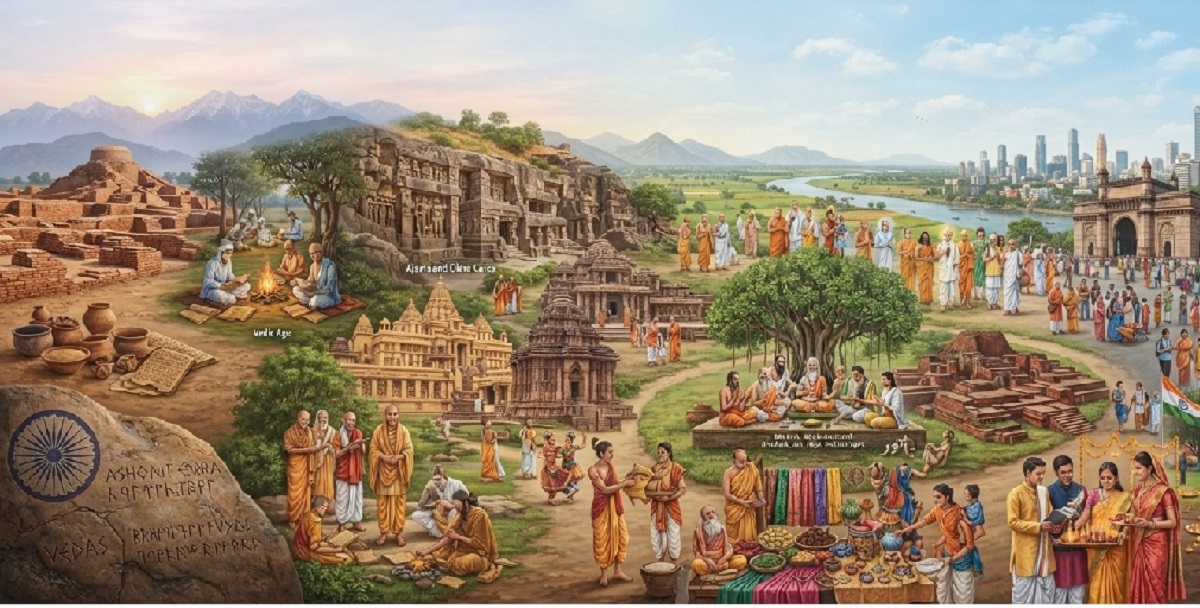
From Ancient Hindu Traditions to Modern Religious Nationalism and Constitutional Democracy. India’s civilisational and socio-cultural foundations developed over thousands of years, deeply influenced by indigenous traditions, particularly those broadly identified with Hinduism and Sanatan Dharma. These traditions evolved long before the arrival of Islam and Christianity in the subcontinent.
India’s Ancient Civilisational Foundations
Known through different historical and geographical designations, including Aryavarta, Bharat and Hindustan, the subcontinent witnessed successive political, cultural and religious transformations while retaining many elements of its ancient philosophical and spiritual heritage.
Unlike religions associated with a single historical founder, Hinduism evolved through a long process involving the Vedas, Upanishads, Puranas, epics, philosophical schools, Bhakti movements and diverse regional traditions.
Hinduism and Sanatan Dharma are therefore among the oldest surviving major religious and philosophical traditions associated with India. However, India’s civilisation cannot be identified exclusively with one religion. Buddhism, Jainism, Sikhism and numerous indigenous and tribal traditions have also made substantial contributions to its intellectual and cultural heritage.
Age of Universe According to Hindu Cosmology
According to Hindu scriptures, one day of Brahma is called a Kalpa. The traditional calculations are as follows:
The Four Yugas (One Maha Yuga or Chaturyuga)
One complete cycle of four Yugas comprises 4,320,000 years.
- Satya Yuga: 1,728,000 years
- Treta Yuga: 1,296,000 years
- Dwapara Yuga: 864,000 years
- Kali Yuga: 432,000 years
Larger Units of Time
- One Manvantara = 71 Maha Yugas = 306,720,000 years.
- One Kalpa = 4.32 billion years, representing one day of Brahma.
- Brahma’s night is equally long, another 4.32 billion years.
- One complete Brahma year consists of 360 such days and nights.
- Brahma’s complete lifespan is 100 Brahma years, traditionally calculated as 311.04 trillion human years.
- Brahma’s 50 years have been completed and his 51st year is underway.
- The present Kalpa is known as the Shveta Varaha Kalpa.
- The seventh Manvantara, governed by Vaivasvata Manu, is in progress.
- The 28th Maha Yuga of this Manvantara is underway.
- We are presently in Kali Yuga.
The traditional calculation places the elapsed time in the present Kalpa at approx 1.97 billion years. 5,127 years of Kali Yuga had elapsed by 2026.
Since 50 Brahma years have been completed, the elapsed cosmic time in Brahma’s life span is 155.52 trillion years.
Population and Military Strength in Hindu Scriptures
The Ramayana, Mahabharata and Puranas describe extraordinarily large kingdoms, populations and military forces. These figures are important to India’s religious and literary traditions.
The Ramayana describes Ayodhya as a prosperous and densely populated kingdom. It also portrays the armies of Rama and Ravana on an extraordinary scale. Popular traditional accounts mention approximately 72 crore Rakshasas on Ravana’s side and 36 crore or more Vanaras and bears on Rama’s side.
According to the Mahabharata, 18 Akshauhinis (colorful army consists of Chariots, elephants, Horses and infantry troops) participated in the 18-day Kurukshetra War. The traditional composition of one Akshauhini was:
| Military component | Number |
| Elephants | 21,870 |
| Chariots | 21,870 |
| Cavalry | 65,610 |
| Infantry | 109,350 |
| Total | 218,700 |
The distribution was:
- Kaurava forces: 11 Akshauhinis = 2,405,700.
- Pandava forces: 7 Akshauhinis = 1,530,900.
The combined military strength was 3,936,600 military personnel, equivalent to approximately 39.37 lakh. The epic portrays the war as a devastating catastrophe that virtually annihilated the participating military forces, leaving only 12 survivors, according to the traditional account. Certain Puranic and popular traditions also describe extraordinarily large numbers associated with Krishna’s Yadava dynasty and Dwarka, including the frequently quoted figure of 56 crore.
Manusmriti and Historical Period of Manu
Manu occupies an important position in Hindu religious and philosophical traditions as an authority associated with creation, social organisation and the principles governing human life. The traditional beliefs associate Manu with the beginning of creation.
The Kalinga War: A Historically Recorded Human Tragedy
A significant contrast to the enormous numerical descriptions in religious epics is the Kalinga War, whose consequences were recorded in Emperor Ashoka’s own Thirteenth Rock Edict. Ashoka ruled approximately from 268 BCE to 232 BCE, and the conquest of Kalinga took place around 261 BCE. According to Rock Edict XIII:
- Approximately 100,000 people were killed.
- Approximately 150,000 people were deported or taken captive.
- Many times that number subsequently died.
This inscription is an important contemporary historical source. Ashoka expressed deep remorse over the suffering caused by the conquest. Unlike the enormous and unverified numerical descriptions in epic narratives, the inscription provides a historical record of a ruler acknowledging the human cost of his own military campaign.
Estimated Ancient Population of Indian Subcontinent.
| Period Mythological / Historical Context Early Manu traditions Manu–Brahma dialogue is 1.97 billion (197 crore) years old. Rama–Ravana War Treta Yuga: approximately 19.00–20.30 million human years ago. Mahabharata Period End of Dwapara Yuga: approximately 432,000 (4.32 lakh) human years ago. Mauryan Period 268–232 BCE, under Ashoka; population estimates remain uncertain. Present Day India’s population: approximately 146 crore. | Arrival of Islam and Muslims in India Islam originated in Arabia in the seventh century CE. Consequently, it could not have been a formative influence on India’s ancient Vedic, Upanishadic, epic or early Puranic traditions. |
Arab traders had maintained commercial relations with India’s western coast even before the advent of Islam. Following its emergence, Muslim merchants and trading communities established connections and settlements along the Malabar and other coastal regions.
The first Turkish and Central Asian military incursions into northern India gained prominence under Mahmud of Ghazni in the early eleventh century.
Over subsequent centuries, Muslim rulers, scholars, traders, artisans, Sufi traditions and ordinary communities became integral to India’s social and cultural landscape. Their contributions to architecture, literature, languages, music, cuisine, administration and urban culture form part of the country’s shared heritage.
Nevertheless, the historical distinction remains important: the arrival of Islam and the establishment of Muslim political power did not create India’s original socio-cultural psychology or its ancient civilisational foundations. Nor can the subsequent hardening of Hindu social and political attitudes reasonably be attributed to the presence of Muslims.
From Traditional Hindu Society to Modern Religious Nationalism
Hindu society was never entirely homogeneous or uniformly moderate. It contained diverse philosophical schools, sectarian differences, caste hierarchies, social reform movements and competing interpretations of religion. At the same time, its history includes longstanding traditions of coexistence, philosophical debate, accommodation and religious pluralism.
The transformation of religious identity into organised modern political nationalism, however, is a comparatively recent development. The political formulation of Hindutva acquired particular significance through V.D. Savarkar’s writings in the 1920s. The establishment of the Rashtriya Swayamsevak Sangh (RSS) in 1925 and the subsequent growth of organised Hindu nationalist politics further shaped this development.
Colonial policies, separate electorates, religious mobilisation, competing nationalisms, Partition and post-independence electoral politics also influenced the changing relationship between religion and political identity.
It would therefore be historically simplistic to attribute the hardening of Hindu political attitudes to the arrival of Muslims several centuries earlier. My contention is that religious and political radicalisation is neither an inevitable consequence of Hindu philosophy nor something that can fairly be attributed to India’s Muslim population.
Indian Muslims: Political Narratives versus Constitutional Realities
The increasingly polarised political atmosphere, amplified by sections of mainstream and social media, has understandably created apprehensions among Indian Muslims. However fear shouldn’t replace informed understanding. Several issues frequently discussed together need to be understood separately.
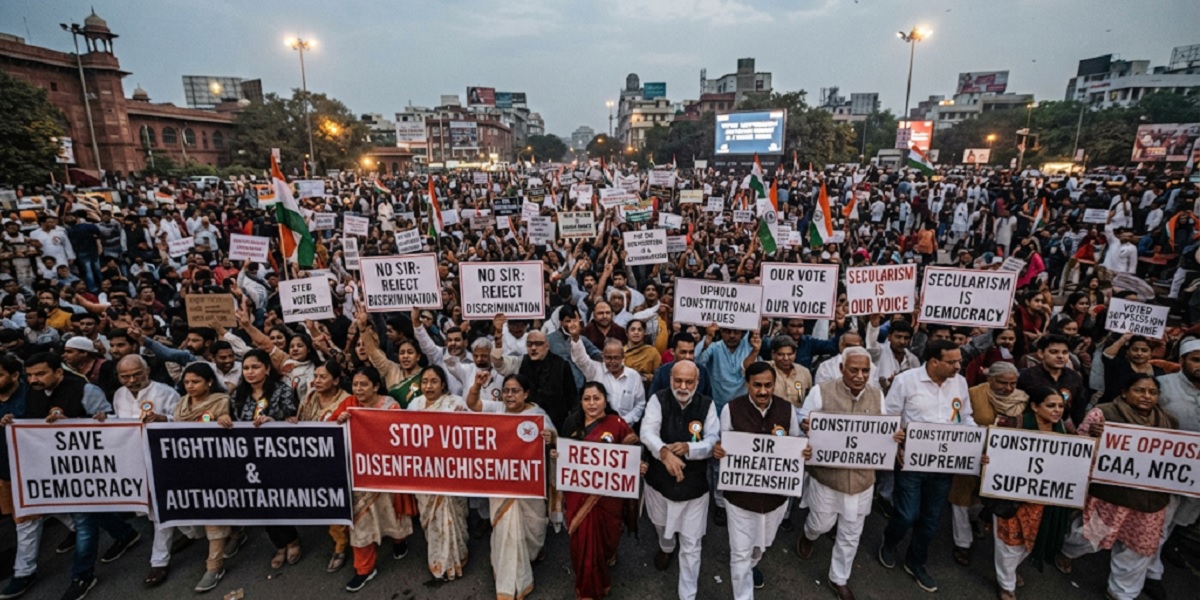
CAA: Provides citizenship to the minority immigrants from Afghanistan, Bangladesh and Pakistan who meet the prescribed conditions, including the entry-date requirement of 31 December 2014. The Act does not, by itself, cancel the Indian citizenship.
NPR: A register of residents for policy planning Creating a database to target government schemes and benefits more accurately.
SIR: An exercise aimed at revising and verifying electoral rolls. Any wrongful exclusion of eligible voters must be addressed through transparent procedures, due process and effective remedies. Electoral-roll revision, in itself, is neither an exercise to disenfranchise eligible citizens nor a mechanism to determine citizenship. However, the possibility of procedural ambiguities, grey areas and unintended exclusions cannot be entirely ruled out.
Census: Collecting demographic, social and economic information for national planning and public policy. Though the citizens are required to provide truthful information, but ensuring inclusion of all families, enumeration is the responsibility of government and the machinery of Census department.
NRC: Any proposed nationwide exercise would entail massive administrative arrangements, extensive procedural safeguards, considerable financial implications and the resolution of complex constitutional, legal and practical questions. If the government contemplates its implementation, the exercise could well prove to be a political and administrative Waterloo. Given these enormous challenges, I don’t think the BJP would be so politically unwise as to embark on such an exercise
Conclusion
India’s history represents extraordinary civilisational continuity alongside successive cultural encounters. Its ancient Hindu and Sanatan foundations preceded the arrival of Islam by many centuries. Its subsequent development, however, was enriched by numerous religious communities.
The arrival of Muslims did not erase India’s indigenous civilisational foundations, nor did it fundamentally transform the historical character of Hindu society. Equally, the later emergence of religious and political radicalism cannot be explained simply by the presence of Muslims.
The more relevant questions concern how historical memories, colonial experiences, political ideologies, religious mobilisation and electoral competition have influenced contemporary social attitudes.
My message to fellow Muslims: Do not allow fear, exaggerated claims or deliberately divisive propaganda to determine your understanding of India’s future. Remain informed, vigilant about constitutional rights and committed to seeking remedies through democratic institutions.
My message to Hindu compatriots: The strength of an ancient civilisation is not measured by its ability to dominate other communities, but by its capacity to accommodate diversity, uphold justice and preserve social harmony.
The constitutional identity of modern India rests on equal citizenship, irrespective of religion. Its future cannot be secured through religious antagonism or mutual suspicion. India’s civilisational roots may be ancient and predominantly shaped by its indigenous traditions, but its Constitution guarantees equality and equity to all Indians.